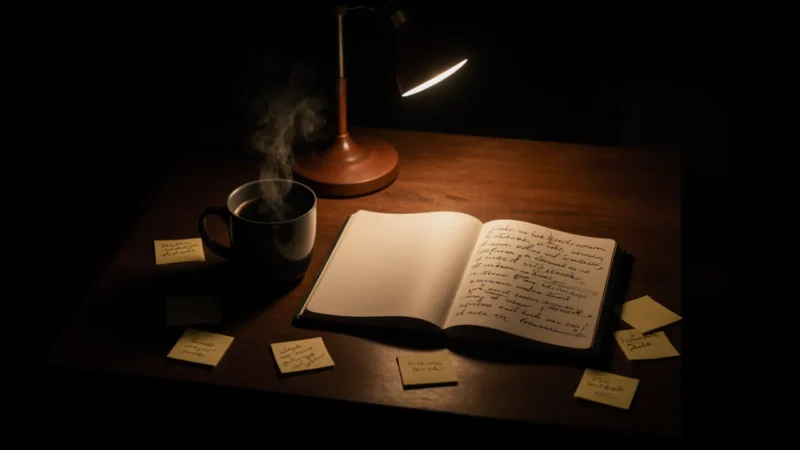
Most People End Their Day on Autopilot
You finish work. Maybe dinner. Maybe some scrolling. Then you fall asleep with a head full of unprocessed thoughts — tomorrow’s worries half-formed, today’s wins forgotten, a vague dissatisfaction you can’t quite name.
This is the default. And it’s costing you more than you realize.
There’s a small, almost embarrassingly simple habit that cuts through this noise: writing your thoughts down at the end of the day. Not a gratitude list. Not a productivity log. Just honest reflection — what happened, how you felt about it, what you want to carry forward.
People who do this consistently report something odd: they feel lighter. Their mornings start clearer. Their anxiety about the next day quietly shrinks overnight.
This isn’t woo. There’s real psychology behind it.

Why Nighttime Reflection Works (The Science Is Interesting)
Psychologist James Pennebaker spent decades studying what happens when people write about their experiences. His research, published in the Journal of Clinical Psychology, consistently showed that expressive writing reduces stress, improves immune function, and helps people process difficult events more effectively than simply thinking about them.
The key mechanism: language. When you put an experience into words, you activate the prefrontal cortex — the rational, narrative part of your brain. This literally dampens the amygdala’s stress response. You’re not just venting. You’re neurologically processing.
Evening is particularly powerful for this because:
- The day’s events are recent enough to recall clearly
- You’re (usually) done reacting and can start reflecting
- Writing before sleep helps consolidate memories during REM cycles
- It creates a mental “save point” — your brain doesn’t have to keep the loop running all night
“Writing is the act of discovering what you believe.” — David Hare
What Evening Journaling Actually Looks Like
Here’s what stops most people: they imagine journaling as sitting down to write three pages of earnest introspection. That’s not it.
An effective evening reflection takes 5–10 minutes. No more. The goal isn’t to write beautifully — it’s to close the loop on the day.
A Simple 3-Part Framework
You don’t need prompts. But if structure helps, this works well:
| Prompt | What It Does |
|---|---|
| What actually happened today? | Grounds you in facts, not feelings |
| What did I feel, and why? | Emotional processing — the core of stress reduction |
| What do I want to do differently? | Closes the loop and sets quiet intention for tomorrow |
That’s it. Answer all three in five minutes and you’ve done something most people never do: intentionally ended your day.
The “Accumulation” Effect Most People Miss
Here’s the part that surprises people: the value of evening journaling isn’t in any single entry. It’s in the pattern that emerges over weeks.
When you look back at three months of daily reflections, you start to see things about yourself that are invisible day-to-day:
- Which kinds of days consistently drain you
- The people or situations that reliably spike your stress
- The activities that produce a quiet satisfaction you never noticed
- Your actual values — not the ones you claim to have, but the ones that show up in how you feel
This is self-knowledge that no personality quiz can give you. It comes from accumulated honest data about your own life.
A private space for your daily thoughts
If you want to build this habit on Android, Daily Reflections – My Thoughts is designed around exactly this kind of end-of-day reflection. It’s calm, private, and doesn’t push notifications at you — just a clean space to write when you’re ready.
Evening Journaling vs. Morning Pages: Which Is Better?
Morning pages (popularized by Julia Cameron in The Artist’s Way) are about clearing mental noise before the day. Evening reflection is about processing what the day produced. They’re different tools.
If you can only do one: evening wins for most people. Here’s why:
- You have actual material to work with — the day happened
- It directly improves sleep quality by offloading rumination
- It gives the next morning a cleaner slate without requiring extra morning time
- The habit is easier to anchor (“write before bed” is simpler than “write before coffee”)
That said, many people eventually do both — morning to set intention, evening to close the loop. If you’re starting from zero, evening is the more forgiving entry point.
How to Actually Build the Habit (Not the Fantasy of It)
The gap between “journaling is great” and “I journal” is a habit-design problem, not a motivation problem.
1. Anchor It to Something You Already Do
Don’t rely on willpower. Attach the habit to an existing cue: “After I brush my teeth, I open my journal.” The specificity matters. Vague intentions fail; concrete triggers stick.
2. Make the Barrier Microscopic
On hard days, permit yourself to write one sentence. “Today was awful and I’m tired.” That’s a valid entry. The goal is showing up, not performing.
3. Keep Your Journal Genuinely Private
If there’s any chance someone will read it, you’ll self-censor. Self-censorship is the death of honest reflection. Use something offline, with a PIN lock if needed. Privacy-first journaling apps exist precisely for this — your entries stay on your device, not a server somewhere.
4. Don’t Skip More Than One Day
Missing one day is fine. Missing two starts to feel like quitting. The research on habit formation (notably James Clear’s synthesis in Atomic Habits) is consistent: the “never miss twice” rule is the most practical commitment you can make to a new habit.
A Note on Digital vs. Paper Journaling
Paper journaling has genuine advantages — no notifications, tactile experience, slower pace. But it has a real problem: friction. You lose the notebook, the pen dries out, you’re traveling, it’s dark in bed.
Digital journaling wins on consistency for most people — especially when it’s a dedicated app with no social features, no syncing to the cloud, and a clean interface that doesn’t feel like another productivity dashboard.
The medium matters less than the practice. Use whatever you’ll actually open at 10pm.

Frequently Asked Questions
How long should an evening journal entry be?
There’s no minimum. Even two or three sentences count. Research suggests the key is emotional honesty, not word count. Five minutes of focused writing produces most of the benefit.
Is journaling before bed bad for sleep?
Generally the opposite — writing processes anxiety rather than feeding it. A 2018 study in the Journal of Experimental Psychology found that writing a to-do list before bed (a form of evening journaling) helped people fall asleep faster than writing about the day’s events. Both beat no writing. Avoid emotionally activating content right before sleep; stick to reflection and intention-setting.
What if I have nothing to write about?
Write “I have nothing to write about” and then keep going. Boredom in journaling is usually a sign of resistance, not an empty day. Ask: what mildly annoyed me today? What was I looking forward to that didn’t happen? The small stuff is often the most revealing.
Should I use prompts or write freely?
Both work. Free-writing (no prompts) tends to surface unexpected insights. Prompts help on low-energy nights when you don’t want to think. A good approach: use the 3-question framework on hard days, free-write when you have something on your mind.
How soon will I notice a difference?
Most people report better sleep within the first week. The bigger cognitive effects — clearer thinking, better emotional self-awareness, reduced anxiety — typically show up around the 3–4 week mark when the habit is consistent.