You’ve been here before.
The alarm goes off at 6 AM. You had every intention of working out. Last Sunday you even made a plan — days, times, exercises. But by Wednesday, the friction of real life wins again, and your streak quietly resets to zero.
This isn’t laziness. It’s not poor discipline. And it’s definitely not a character flaw.
It’s a design problem. The way most people approach workout consistency is structurally broken — and once you understand why, the fix becomes surprisingly obvious.

The Motivation Trap (Why Willpower-Based Fitness Always Fails)
Every January, gyms fill up. By February, they’re empty again. This isn’t because people stop caring — it’s because the fitness industry has sold everyone the wrong product.
The product is motivation. Pre-workout hype. Transformation stories. “No excuses” content. And motivation works — for about 72 hours.
After that, your brain does what brains are designed to do: conserve energy, avoid discomfort, and default to established patterns. This is biology, not weakness.
“Motivation is what gets you started. Habit is what keeps you going. But neither will stick without a feedback loop that makes progress visible.”
The problem with motivation-driven fitness is that it puts you in a constant battle with yourself. Some days you win. Most days, when you’re tired, stressed, or just done, you lose.
The people who stay consistent for years? They stopped relying on motivation long ago.
The Science Behind Workout Habit Formation
Why Your Brain Resists Exercise (Even When You Want to Go)
The basal ganglia — the brain’s habit formation center — works through a simple loop: cue → routine → reward. The issue with working out is that the reward (feeling fit, looking better) is delayed by weeks. The discomfort is immediate.
Your brain is quite literally bad at valuing delayed rewards. This is called hyperbolic discounting — a well-documented cognitive bias where humans consistently prefer smaller, sooner rewards over larger, later ones.
So the comfort of your couch at 6 PM always feels more valuable than the body you want in six months. That’s not irrationality — it’s just how brains compute value.
The Missing Piece: Immediate Visual Proof
What changes everything is shortening the feedback loop. If your only reward is “I’ll look better eventually,” your brain won’t cooperate. But if completing today’s workout gives you an immediate, visible signal of progress, the habit loop clicks into place much faster.
This is why GitHub’s contribution graph is so addictive for developers. The green squares aren’t tracking output quality — they’re tracking presence. And presence, over time, becomes identity.

The Heatmap Effect — How Seeing Your Consistency Changes Everything
Behavioral science has a term for this: implementation intentions combined with progress monitoring. Studies show that people who track their exercise visually — not just log it in a list — are significantly more likely to maintain the habit long-term.
A heatmap does something clever: it converts abstract consistency into a visual asset. You don’t want to break the chain. Missing a day doesn’t just mean skipping a workout — it means leaving a gap in something you can see.
This small psychological shift is enormous in practice.
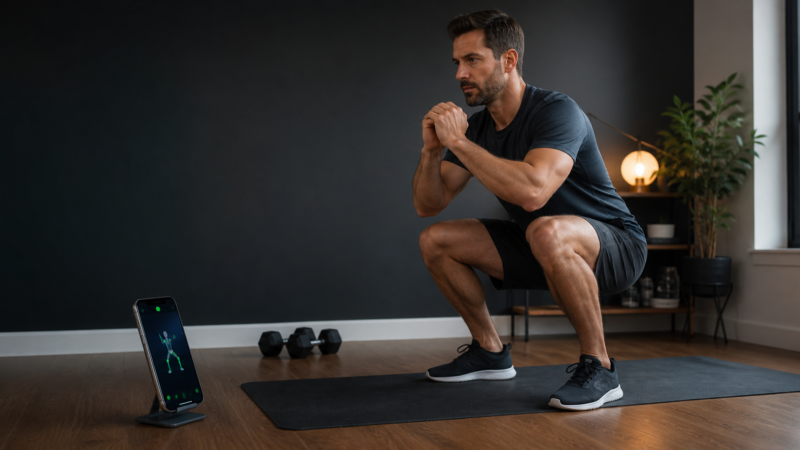
Apps that combine AI-assisted tracking with a visual consistency layer — like RepCounta AI on iPhone — leverage exactly this principle. The AI counts your reps so your brain doesn’t have to focus on numbers. The heatmap turns your consistency into something you actually look forward to building.
A smarter way to build the workout habit
If you want tracking that gets out of your way — no manual logging, no counting in your head — AI-powered rep counters for iPhone handle the numbers automatically. What’s left is just showing up.
A 4-Part Framework for Lasting Workout Consistency
Motivation fades. Here’s what actually keeps people going:
1. Make Starting Frictionless
The biggest barrier to working out isn’t the workout — it’s starting. Lower the entry point radically. “I’ll do 10 pushups” beats “I’ll do a 45-minute session” every single time, because your brain will actually do the former.
2. Remove the Counting Burden
One of the underrated reasons people quit home workouts: counting reps while also maintaining form while also pushing through fatigue is genuinely exhausting. Anything that removes cognitive load during the workout makes it more likely you’ll finish — and come back.
3. Build a Visual Streak
Track completion, not perfection. A 10-minute session counts. The habit is showing up. Your visual consistency map should reflect that, rewarding presence over performance.
4. Review Your Pattern Weekly
Spend 60 seconds every Sunday looking at your last 7 days. Where did you skip? What was happening that day? This kind of reflection — not self-judgment, just curiosity — is what separates people who build lasting habits from those who keep restarting.
Workout Tracking Methods: Which One Actually Builds the Habit?
| Tracking Method | Habit-Building Power | Friction Level |
|---|---|---|
| Mental memory | ❌ Very low | Low to start, high over time |
| Paper log / journal | ⚠️ Low–Medium | Medium (easy to abandon) |
| Generic fitness app | ⚠️ Medium | Medium (manual entry) |
| AI rep counter + visual heatmap | ✅ High | Low (automatic tracking) |
The highest habit-building combination is automatic tracking + visual accountability. When the system handles the data collection, your only job is to show up.
What Exercise Science Says About Long-Term Adherence
A 2021 systematic review in the British Journal of Sports Medicine confirmed that self-monitoring — tracking your own exercise behavior — is one of the most consistently effective behavior-change techniques for long-term physical activity.
Specifically, visual self-monitoring outperformed simple logging because it engages a different cognitive process. Instead of recording data, you’re reading a narrative about yourself. And humans are incredibly motivated by the stories they’re writing about their own lives.
The key is making that self-monitoring as effortless as possible. The more steps between “I worked out” and “I can see that I worked out,” the faster the habit erodes.

Frequently Asked Questions
How long does it take to build a consistent workout habit?
Research by Phillippa Lally at University College London found habits take anywhere from 18 to 254 days to form, with 66 days being the median. For exercise, most people see a meaningful “default” habit emerge after 6–8 weeks of consistent daily tracking. The key is maintaining visible progress — not breaking the chain — through the first 30 days.
Is it okay to miss a workout day?
Yes — and this is critical. Missing one day doesn’t break a habit. Missing two days consecutively is what disrupts the pattern. The research is clear: never miss twice. One missed day is a pause. Two in a row is the beginning of quitting. A visual tracker that shows your overall pattern (not just today’s streak) helps you see this perspective clearly.
Do I need to track reps to build a workout habit?
Not necessarily — but tracking adds a layer of accountability and progress visibility that significantly improves retention. Even if you don’t care about rep counts, the act of logging a completed session builds the habit loop. When rep counting is automated by AI, it removes one more cognitive burden so you can focus on form and effort.
What’s the minimum effective workout for building consistency?
For habit formation — not fitness results — even 5–10 minutes counts. The goal in the first 30 days is to make “working out” a daily identity act, not a performance milestone. Start with something so small you can’t say no. 10 pushups. 20 squats. 5 minutes. The habit is showing up. The results follow from the habit.
Can AI fitness apps really help with workout consistency?
The evidence points to yes — specifically because they reduce friction at two key points: during the workout (no manual counting) and after (automatic logging). Tools like AI fitness trackers on iPhone that generate visual consistency reports tap into a well-documented psychological principle: when progress is visible, it’s more likely to continue.