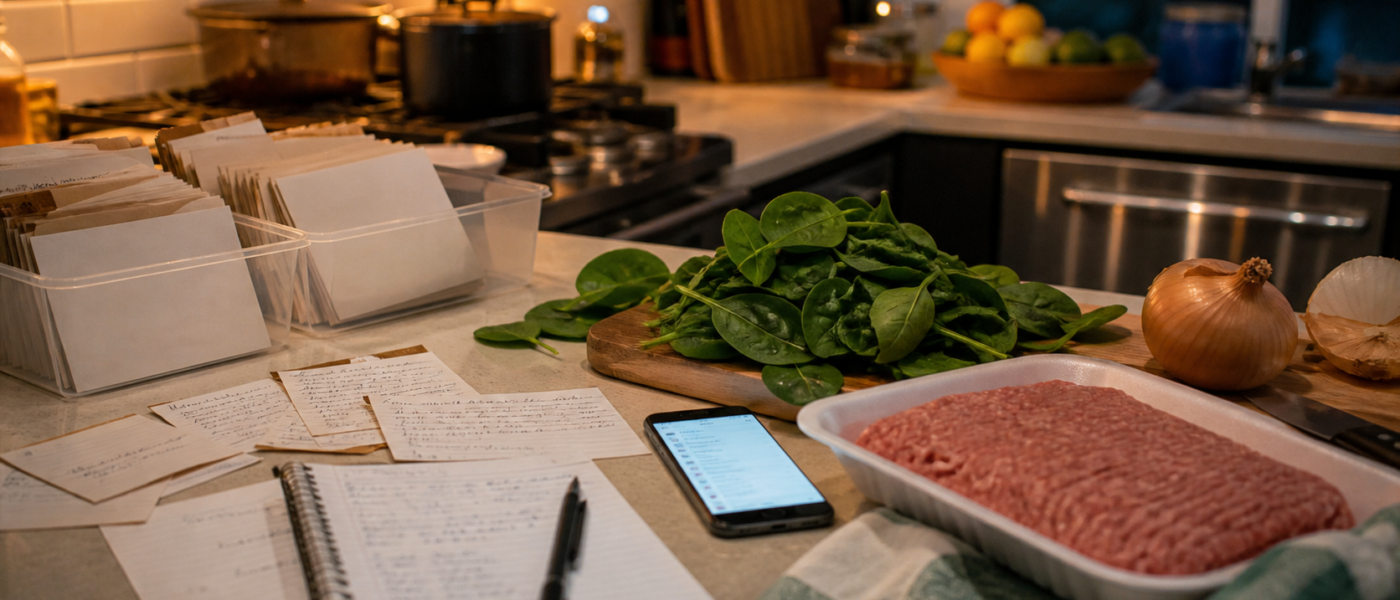
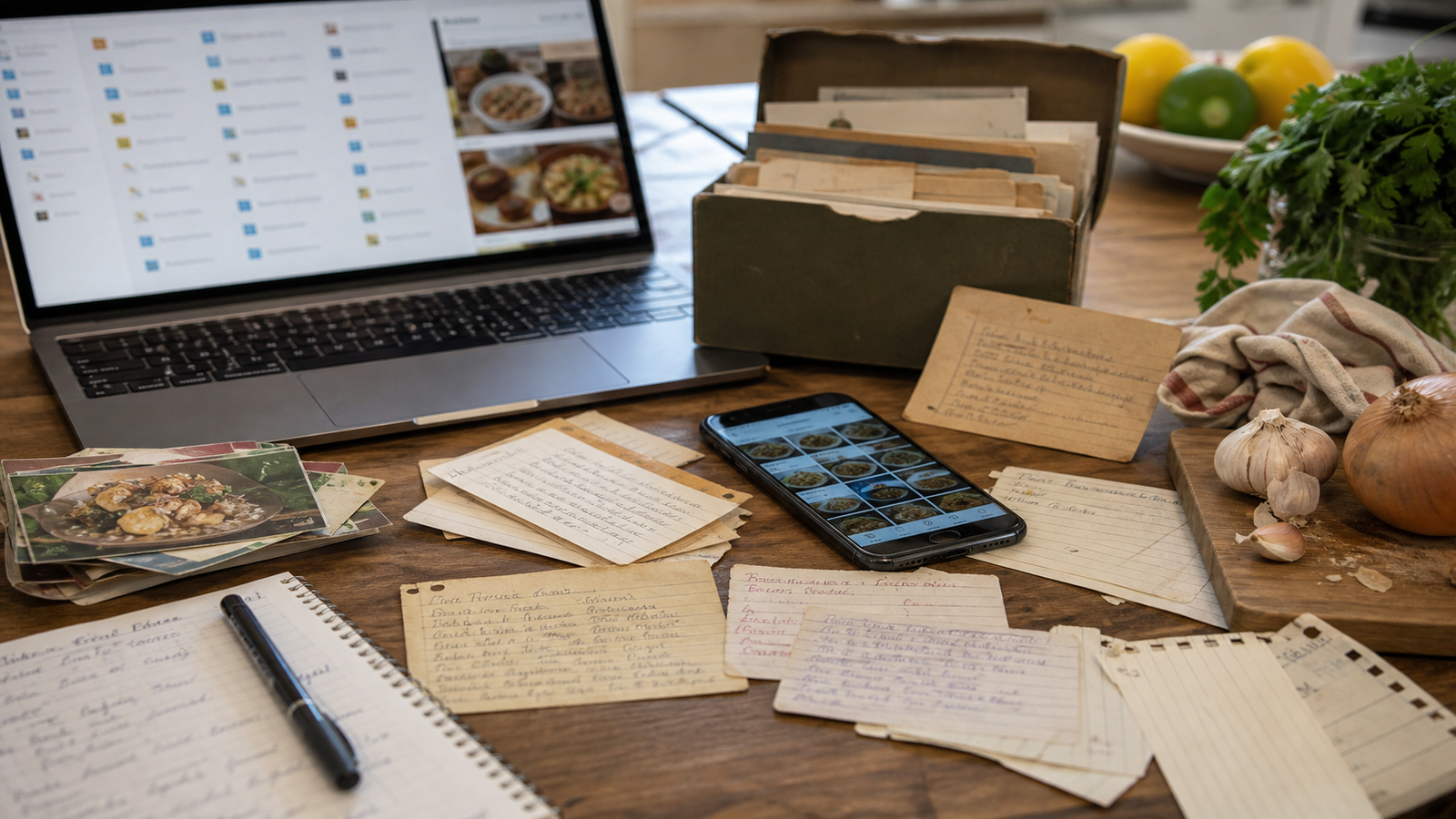
You have the recipes. That’s not the problem. They’re in your camera roll from a cookbook page you photographed in a bookstore, in eleven browser bookmarks, in a text thread with your sister, in a shoebox of cards written in handwriting you can barely read anymore. The problem shows up at six o’clock on a Tuesday, when you have ground turkey and a half bag of spinach and roughly zero patience, and you cannot find the one thing you know you already have.
Most advice about how to organize personal recipes treats this as a storage question — where should everything live? That’s backwards. Storage is easy. Retrieval under pressure is the hard part, and it’s the only part that matters. Build for the tired version of yourself and the rest sorts itself out.
Start with the ones you actually cook
The instinct is to begin at the beginning: open the screenshots folder, start at the top, work through all of them. You will quit on day two. Everyone quits on day two.
Instead, write down every dish you’ve made in the last two months from memory. That list is your real collection — the working set. Everything else is aspiration, reference, or sentiment, and those are different categories with different needs.
Get the working set organized first, completely, in whatever system you choose. It’s a small enough job to finish in an evening, and finishing is what makes the habit stick. The rest can wait in a pile labeled “unsorted.” A pile you know is a pile beats a pile you’re pretending is a system.
Sort by the question you’ll ask, not the category it belongs to
Cookbook logic — appetizers, soups, poultry, desserts — is publisher logic. It exists so a book has chapters. It’s almost useless for a personal collection, because at 6pm you are not asking “what’s in the poultry section.” You’re asking something much more specific.
Watch what you actually ask yourself:
- What can I make in under 30 minutes? Time is the most common filter and the one people most often forget to record.
- What uses this thing before it goes bad? The half bunch of cilantro, the yogurt near its date.
- What can I make with only what’s already in the house? A pantry-only flag is worth more than any cuisine label.
- What does everyone at the table eat without complaint? The short list of reliable wins.
- What can I make ahead or freeze? Sunday’s question, but it feeds Tuesday.
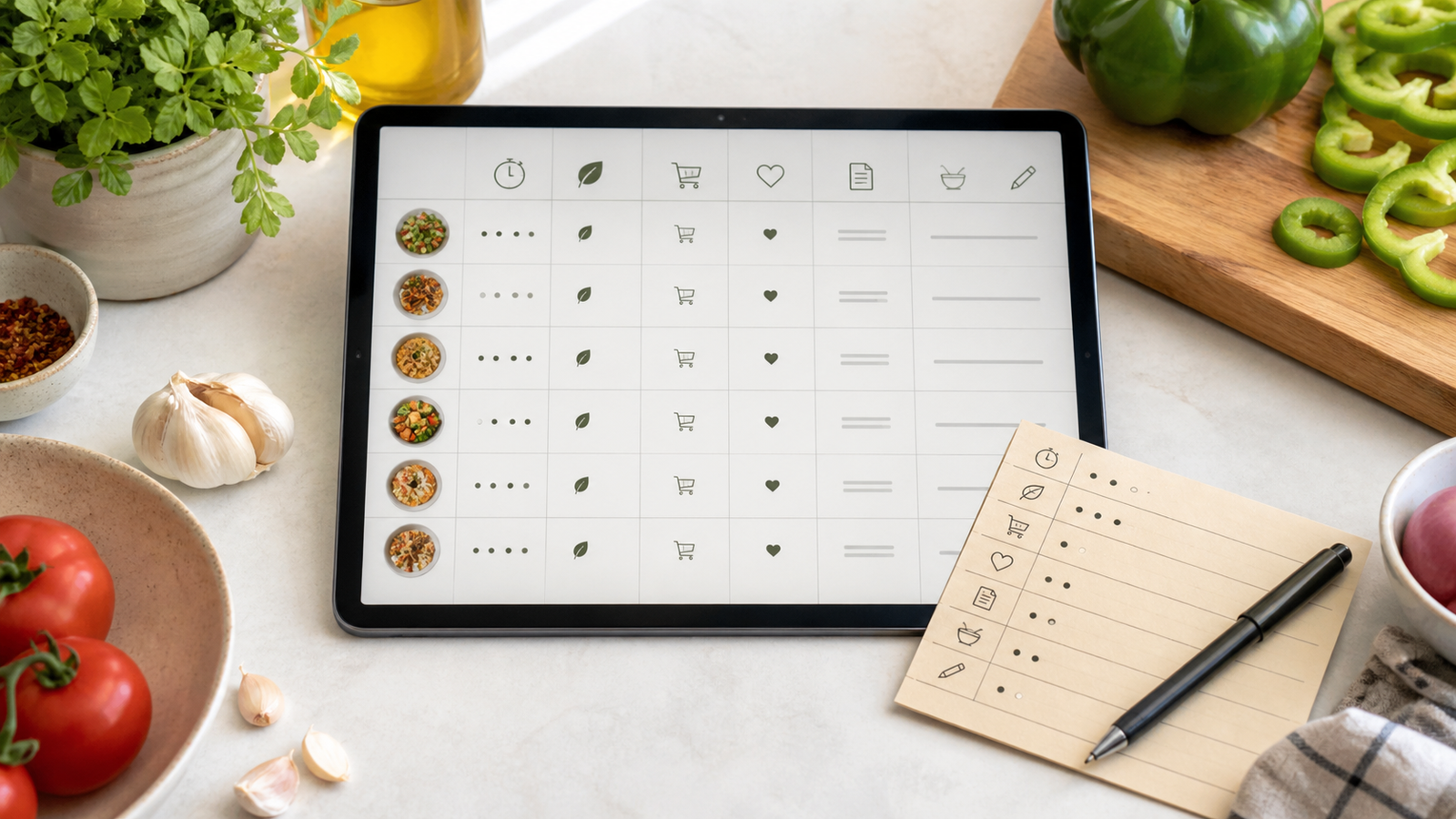
Those questions are your organizing structure. Effort level, main ingredient, active time, and “would I make this again” will do more work for you than any traditional category scheme. Cuisine is fine to record, but be honest about how rarely you search by it.
Decide what a recipe entry needs to contain
A saved link is not an organized recipe. It’s a promise to do the organizing later, at the exact moment you have the least capacity for it — and links break, sites get redesigned, and paywalls appear where none used to be.
“A saved link is not an organized recipe. It is a promise to do the organizing later, at the exact moment you have the least capacity for it.”
An entry you can cook from needs, at minimum:
- A name you’d actually use. “Mom’s chicken thing,” not “Weeknight Skillet Chicken with Preserved Lemon and Herbs.” Name it what you call it out loud.
- The ingredients, with amounts. This is the part you need at the store, and the part a bookmark can’t give you offline in a grocery aisle with bad signal.
- The method, in your own compressed shorthand. You do not need the eight-hundred-word headnote about a trip to Provence.
- The changes you made. Half the salt. Skip the anchovy. Doubles fine. This is the highest-value information in your entire collection and the thing no external recipe will ever have.
- A time estimate that’s true for you, not the optimistic number printed on the page.
- Where it came from, if it matters — for the inherited cards especially, since provenance is half the point.
If a recipe isn’t worth ten minutes of typing, it probably isn’t worth keeping. That’s a useful filter, not a burden.
| What you actually ask at 6pm | The field that answers it |
|---|---|
| What can I make in under 30 minutes? | Active time — your real number, not the printed one |
| What uses this before it goes bad? | Main ingredient |
| What can I make with only what is in the house? | A pantry-only flag |
| What does everyone eat without complaint? | Would I make this again |
| What can I make ahead or freeze? | Freezes well |
Handle the three piles differently
Screenshots are the worst offenders, because they’re invisible. They sit in the camera roll between a parking spot photo and a picture of your dog, and image search will not find “the pasta one.” Work through them in batches of ten. Most will turn out to be things you saved on impulse and have no intention of making — delete those without guilt. The survivors get typed in properly.
Bookmarked links need triage: have you made it, or do you just like the idea of it? Made it goes into the collection as a real entry with your notes. Haven’t made it goes into a separate “want to try” list, kept deliberately short. A want-to-try list of two hundred items is a wish, not a plan.
Index cards and handwritten pages deserve two passes. Photograph them first — the handwriting is part of what you’re keeping, and paper is fragile. Then transcribe the content separately so the recipe is searchable. Transcribing also surfaces the gaps that make old family recipes hard to cook from: “a teacup of flour,” “bake until done.” Note your best guess when you fill one in, so the next cook knows what was inherited and what was reconstructed.
Pick a container, then stop shopping for containers
Recipe manager apps exist and many handle web clipping, scaling, and shopping lists well. General note apps work fine too, if you commit to a consistent structure — the failure mode there is that every note ends up formatted differently, which quietly ruins searching. A binder with plastic sleeves is a perfectly legitimate answer if your kitchen is where you think best. A spreadsheet is underrated for the same reason: you can sort and filter by time, effort, and main ingredient in a way that maps directly onto the 6pm question.
What matters is that you choose one and stop. Migrating between systems feels like progress and produces none. The collection only gets useful once it’s been in one place long enough to accumulate your notes.
A simpler way to keep a recipe box
If you want something structured but not rigid, Pocket Tables is an iPhone app for building your own small databases — you start from a template, like the recipe template, then add or delete fields until the table matches how you actually search: active time, effort, freezes well, kid-approved, whatever you need. No account, and the data stays on your phone. The honest caveat is that everything is typed in by hand — there’s no URL import, no automatic capture from a screenshot, no meal-plan generation, and no Android version. That manual entry is a real cost, though it doubles as the triage step that keeps a collection small enough to be useful.
Keep it alive with a two-minute habit
A collection decays if it only ever receives. The maintenance is smaller than you think: right after you cook something, while the pan is soaking, add one line to the entry. Too salty. Needed 10 more minutes. Kids ate it. Make again.
Do that for a few months and something changes in kind. You stop having a folder of other people’s recipes and start having a record of what works in your kitchen, for the people you feed, at the speed you actually cook. That’s the collection worth building — and it’s the one that answers the Tuesday question in about fifteen seconds.
Common questions
How should I organize my recipes?
By the question you will ask when you are tired and hungry — time, effort, main ingredient, whether it freezes — rather than by cookbook categories like appetizers and desserts. Those exist so a book has chapters, not so you can find dinner.
Where do I start if I have hundreds saved?
Write down every dish you have actually cooked in the last two months. That list is your real collection, and it is small enough to organize in an evening. Everything else goes in a pile marked unsorted, which is honest and fine.
Is it enough to just bookmark recipe links?
Not really. Links break, sites get redesigned, paywalls appear, and a bookmark cannot give you an ingredient list in a grocery aisle with bad signal. If a recipe is worth keeping, it is worth ten minutes of typing.
What should each recipe entry contain?
A name you would actually say out loud, ingredients with amounts, the method in your own shorthand, a time estimate that is true for you, and — most importantly — the changes you made last time.
What do I do with old handwritten recipe cards?
Two passes. Photograph them first, because the handwriting is part of what you are keeping and paper is fragile. Then transcribe the content separately so it is searchable, noting your best guess wherever the original says something like ‘bake until done’.