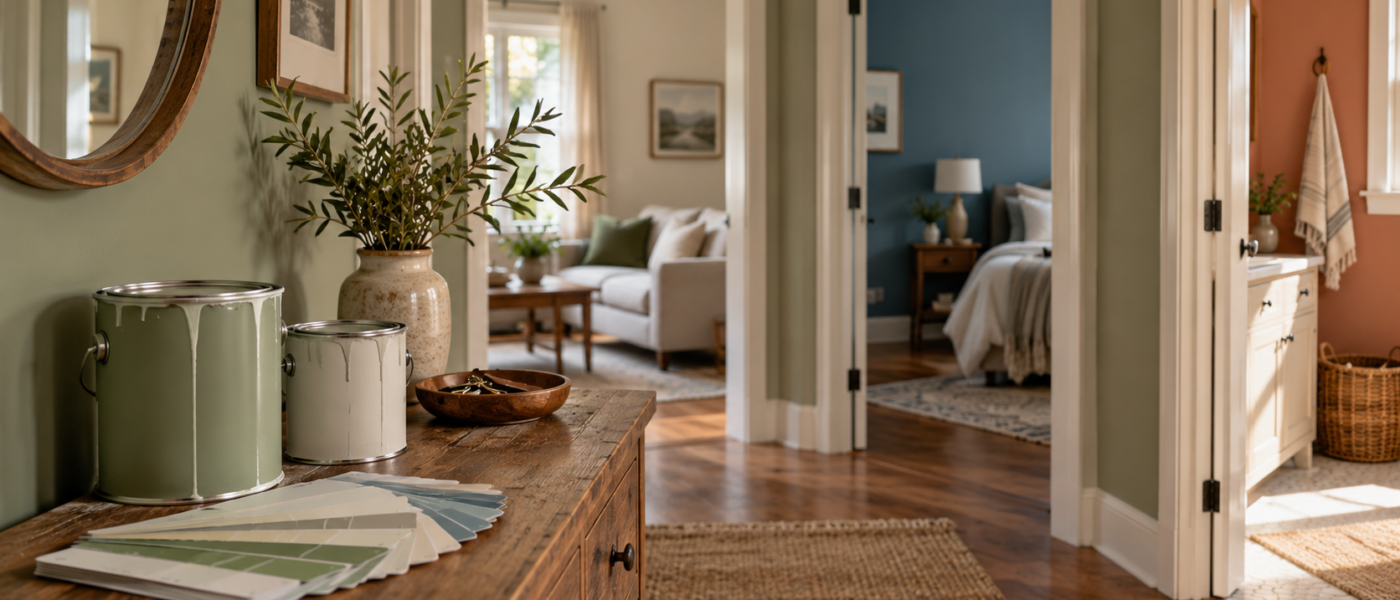
The standard way to keep track of paint colors is to keep the cans. You push the leftovers onto a shelf in the garage, write “hall” on a lid in marker, and consider the problem handled. It isn’t handled. It’s deferred, and the deadline belongs to somebody else.
Four years later a chair back scuffs the hallway wall. You go to the shelf. There are nine cans. Three have nothing written on them. One lid says “hall” in marker that has smeared into a gray cloud. Two were already there when you moved in. Whether any of them is worth opening is a separate question, and not the one you wanted to be asking at 8pm on a Saturday.
That’s what makes a paint record strange. It produces nothing for years, then produces everything in one moment — and if it isn’t there, the fallback is a store counter, a flake of drywall and a hopeful expression.
Why the leftover can is not a record
Cans fail as a filing system in three ways, and they fail quietly, so you find out at the worst possible moment.
They leave. Cans get cleared out in a tidy-up, left behind in a move, or taken away by whoever did the work. All of it is invisible until the day you go looking.
The label degrades. What you need from a can is a small block of printed text, often on a sticker with a drip down one side of it. Garage shelves are not archival storage, and marker on a lid fades — along with your certainty about what you meant by “hall.”
The can doesn’t know where it went. It tells you what the paint is, never what you painted with it. One gallon might have covered the hallway, the stairwell and a closet, and nothing on the tin records that split. The reverse trap is worse: three rooms you remember as “the same white” turn out to be three different whites bought over six years, and you find out after rolling one of them onto the wrong wall.
The can is material; the record is identification. Keeping material is optional and takes up space. Keeping identification costs nothing, and it’s the half you can’t reconstruct later.
The code is the only field that identifies the paint
If you record one thing and nothing else, record the code.
Color names are written to be chosen from, not looked up. They’re warm, memorable and completely unstable: names get retired when a range is refreshed, reused later on something slightly different, and shelved next to three near-identical siblings. “Soft Linen,” written in a notebook in 2019, may bring back nothing at a counter today — or, worse, something that is nearly but not quite what’s on your wall.
A code doesn’t drift like that. It’s the string the mixing system acts on, and what a person behind a counter can act on immediately. Two things to get right. A code without a brand is half a field — the same string can exist in two systems and mean two different colors, so brand and code travel together or not at all. And write the name as well: the name is how you recognize the row in your own list, the code is how anyone else finds the paint.
Also worth saying plainly: “white” is not a color. One manufacturer can carry more near-whites than you could tell apart in a lineup, let alone across a room in evening light. Your eye is not a measuring instrument, and your memory is worse.
“A color name is a story somebody told about the paint. The code is the paint.”
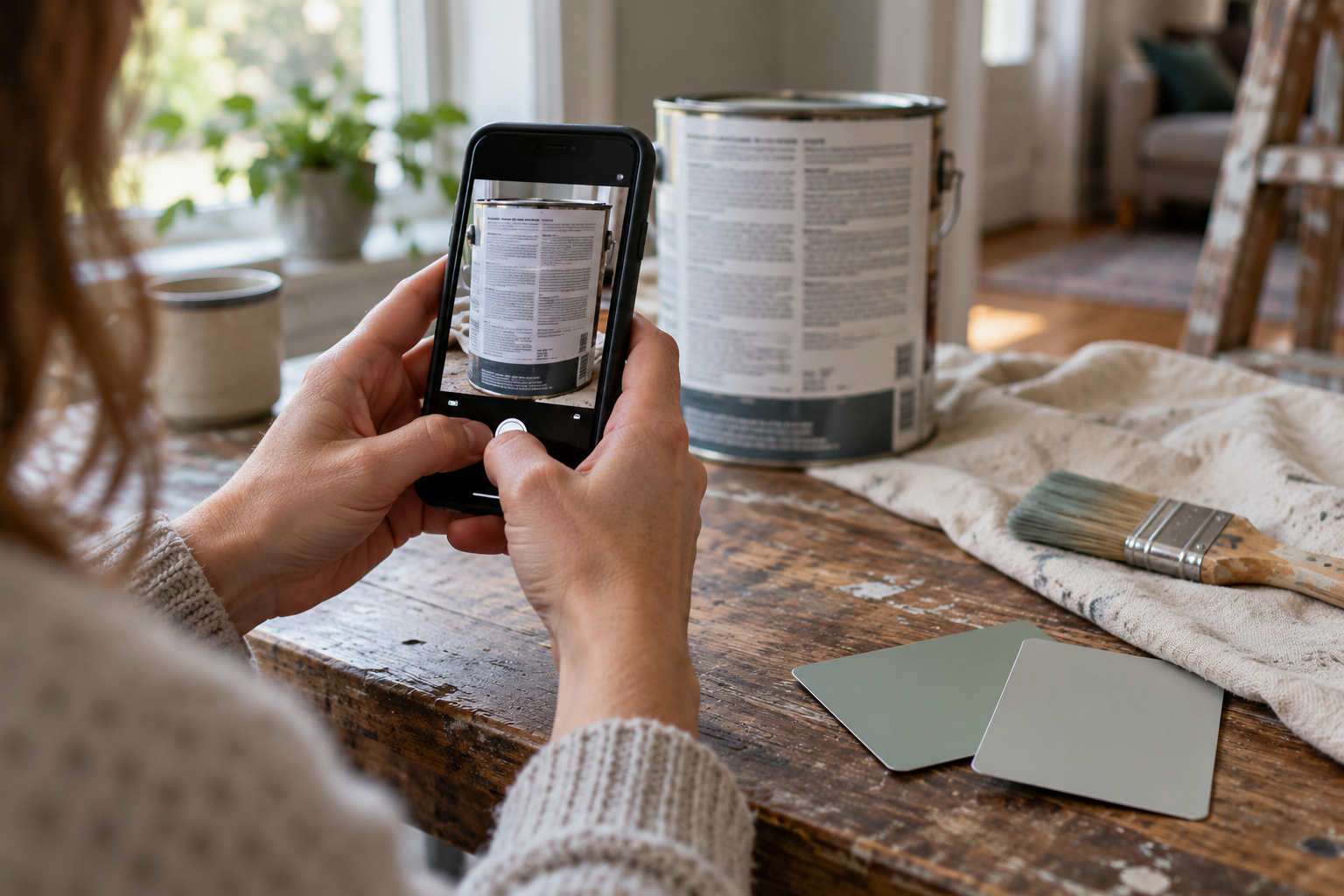
And the part people skip because it feels too easy: a photo of the label beats a careful transcription. Transcription loses whatever you didn’t know mattered — the base, the sheen line, the store’s sticker, an order reference printed underneath — and it invites the one error that ruins the exercise, a zero becoming an O in your own handwriting. Keep both: the typed code so the row is searchable, the photo so you can check it when something doesn’t add up.
The fields that earn their place
The unit of the record is not the room. It’s the room and the surface. Walls, trim and ceiling in one room are usually three different paints, frequently three different finishes, and sometimes three different brands bought on three different weekends. A row that says “kitchen” and gives one color is a row you won’t trust in four years, because you won’t know which part of the kitchen it meant. One row per surface, and rooms with a feature wall get two rows rather than one row with a comma in it.
| Field | What it has to do for you in four years |
|---|---|
| Room and surface | Point at exactly one thing — “upstairs hall, walls,” not “hall” |
| Brand | Make the code mean something; a code alone belongs to no system |
| Color name | Let you recognize the right row while scanning your own list |
| Color code | Survive renaming and discontinuation, when the name no longer identifies anything |
| Finish | Stop you matching the color and missing the surface — the classic touch-up failure |
| Date painted | Settle which of two rows for the same wall is the current one |
| Photo of the label | Carry everything you didn’t think to type |
| Note | Hold the odd detail — who did the work, where the leftover went, which rooms share this row |
Eight columns sounds heavy until you notice six are copied off one label in one go and never change again. This is a write-once record, not a habit to sustain.
Two ways to build it: the honest way and the archaeology version
The honest way is to log it on the day you paint. The can is open on the floor, the label is clean, and you know for certain which wall you just rolled. Five minutes while the second coat dries and the row is done forever. Photograph the label then, before the can gets wiped down and shelved.
Do the same for work other people do. A decorator knows exactly what went on your walls on the day they finish; six months later you’re reconstructing it from a line item on an invoice. Ask for brand, code and finish, per surface, while they’re still there.
The archaeology version is for a house you’ve already lived in for ten years, where some of this is simply gone. The temptation is to fill the table in from memory, because a complete table looks like success. Resist it. A guessed code is worse than an empty one: a blank sends you to a store with a sample and the right expectations, a guess sends you home with a gallon of the wrong thing.
So the rule for the backfill pass: record what you can verify, mark everything else unknown. Unknown is a legitimate value, not a failure — it tells you which rooms need a different approach.
Places worth checking first: the cans still in the house; the inside of a cupboard door, where some painters write the color and date; receipts, order history and emails from when you were decorating, which often carry the full product line in the item description; a decorator’s invoice; the previous owner, who may remember. And your photo library — pictures taken during the work sometimes show a can on a dust sheet with the label facing the camera.
When something is genuinely unrecoverable, record the state of play rather than the color. “Unknown; sample chip taken from behind the radiator, envelope in the hall drawer” is a complete, honest, actionable row.
Where the record lives
This list has a demand the others don’t: it has to survive a decade. It will outlive your current phone and possibly your current house. So the test isn’t which tool is nicest to type into — it’s what you can still open and search in 2036.
A note in a notes app works until you want every trim row in the house at once, or want to sort by date. For a small flat with one painting event, it’s fine.
A photo album called “Paint” beats nothing, but an album of labels isn’t searchable by room. It’s the right half of a good system, not the whole one.
A spreadsheet handles fields and sorting perfectly, is awkward to attach photos to, and is unpleasant to update on a ladder — fine for a record you touch twice a year.
A strip of tape inside a cupboard door, with room, code and finish written on it, sounds primitive and is remarkably durable. It’s the only version that survives you forgetting the record exists. Treat it as a backup, not a replacement.
A database-style app gives you defined fields, phone-side entry and filtering, which suits a record built one room at a time over years rather than in a single sitting.
If you want fields rather than a note
Pocket Tables is an iPhone app — a flexible personal database where you’d start from the home repairs template and rename its fields to room, surface, brand, color name, code, finish and date; there’s no account and the data stays on the phone. The honest trade: every row is typed in by hand, and Pocket Tables does no scanning, no lookup of color codes, no sync, no sharing and no backup to a server, and there’s no Android version. For a record this long-lived that last point matters — keep a copy somewhere else as well, whatever you use.
Keeping it accurate as the house changes
The record goes stale the instant somebody repaints, and the failure mode is specific: a confident row describing a color that is no longer on the wall is more dangerous than no row at all, because you’ll act on it without checking.
The fix is one habit. When a surface gets repainted, update it that day — not that week — in the same five minutes you’d spend cleaning up.
Unlike most household lists, this one is worth keeping history on. Don’t overwrite the old row; mark it superseded and add a new one. Knowing what’s under the current coat is useful, and so is knowing which rooms get repainted and which never do.
The last thing this record does is get handed over. When you move out, a one-page list of every surface with brand, code and finish is one of the few documents a new owner will genuinely thank you for — and exactly the one you wish you’d been given, four years ago, with a scuff on the wall.
Common questions
What if I only know the color name and not the code?
Record the name, record the brand if you know it, and flag the row as incomplete. A name plus a brand is often enough for a store to find the code for you — a five-minute errand you can run at your convenience rather than mid-repair. What you shouldn’t do is write a plausible-looking code next to a name you’re unsure about.
Do the ceiling and the trim really need their own rows?
Yes — they’re usually different paints in different finishes, and the point of the record is that it answers a question without you remembering anything. A single “living room” row forces you to reconstruct which part of the room it meant, which is the work you were trying to avoid.
Is a photo of the can enough on its own?
It’s the most valuable single item, but it isn’t a record. A folder of label photos can’t tell you which room each one went on, can’t be sorted, and can’t be searched for “all the trim.” Type the fields in and keep the photo attached to the row as the source of truth behind it.
How do I handle rooms painted before I moved in?
Create the rows anyway and set them to unknown. An explicit unknown tells you which rooms can’t be touched up from the record, and it gives you a row to fill in the day you eventually repaint that surface — which is how these lists quietly complete themselves over a few years.
If I have the record, do I still need the leftovers?
That’s a storage decision rather than a record-keeping one, and it depends on your space. What the record changes is the stakes: once brand, code and finish are written down and photographed, losing a can is an inconvenience instead of a dead end. Make the record first — it’s the part that can’t be replaced.