The most common way to kill a houseplant is to be reliable about it. Every Sunday morning, same route through the apartment, same measuring cup, same amount into every pot. It feels like diligence. What it actually does is deliver a fixed input to a plant whose water demand changes constantly — with light, temperature, humidity, pot size, root mass, and the season.
A plant in a dim corner in January uses a fraction of the water it used on a bright July afternoon. Watering it identically in both months means the January pot never dries out. Roots sit in saturated soil, oxygen gets displaced, and the fine feeder roots start to fail. The leaves go limp and yellow — which looks exactly like thirst — so the natural response is to water more. That feedback loop is why overwatering is so much harder to catch than neglect.
The calendar is a proxy for the thing you actually care about
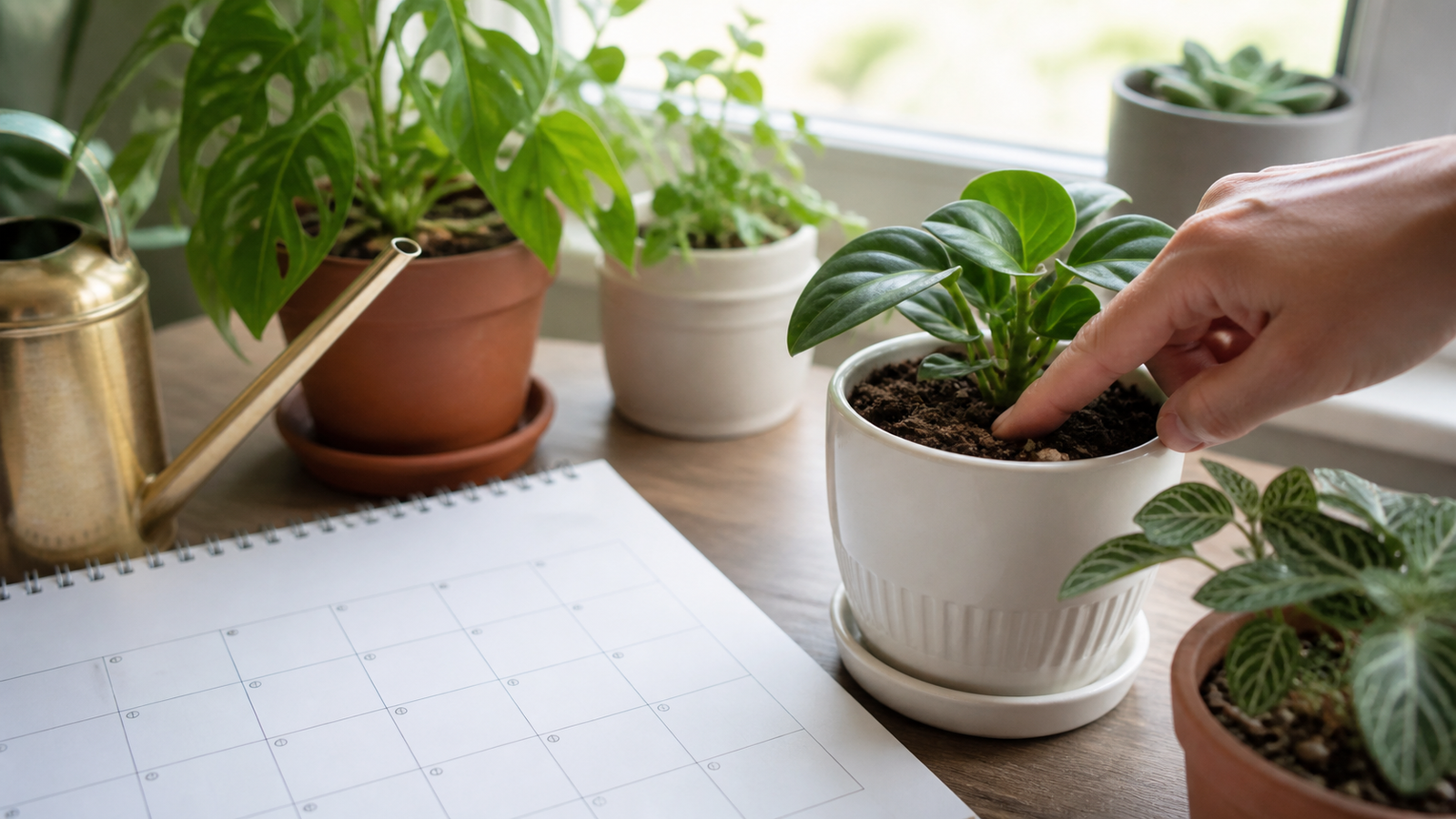
When you water on a weekly interval, you are making a bet: that seven days is roughly how long this pot takes to dry to the point where the plant needs more. Sometimes that bet is right. But it was only ever an estimate of the real variable, which is how wet the root zone is right now.
“Overwatering looks exactly like thirst, which is why it is so much harder to catch than neglect.”
The fix is not a better interval. It is to stop treating the interval as the instruction and start treating it as data. Water when the soil says to. Record when that happened. Over a few cycles, the gaps between waterings tell you what the plant is actually doing — and they will not be evenly spaced.
This is the shift that makes a houseplant care schedule worth keeping: it stops being a list of chores due on Sunday and becomes a record you read backwards to learn something.
What to record for every plant, once
These are the fields that rarely change but explain almost everything about why a plant behaves the way it does. Set them up once per plant and mostly leave them alone.
- Name and location. Not just “monstera” — “monstera, north bedroom window.” Two of the same species in different rooms are effectively two different care problems.
- Light description. In your own words, honestly. “Direct sun until noon.” “Six feet from a west window.” “Under a shelf, indirect only.” This is the single biggest driver of how fast a pot dries.
- Pot size and material. Terracotta breathes and dries faster than glazed ceramic or plastic. A small pot dries faster than a large one. A pot with no drainage hole is a separate problem entirely.
- Soil mix. Chunky aroid mix, dense bagged potting soil, something with added perlite — this changes drying time dramatically.
- Date acquired and date last repotted. A root-bound plant drinks faster than one recently moved into fresh soil.
What to record every time you water
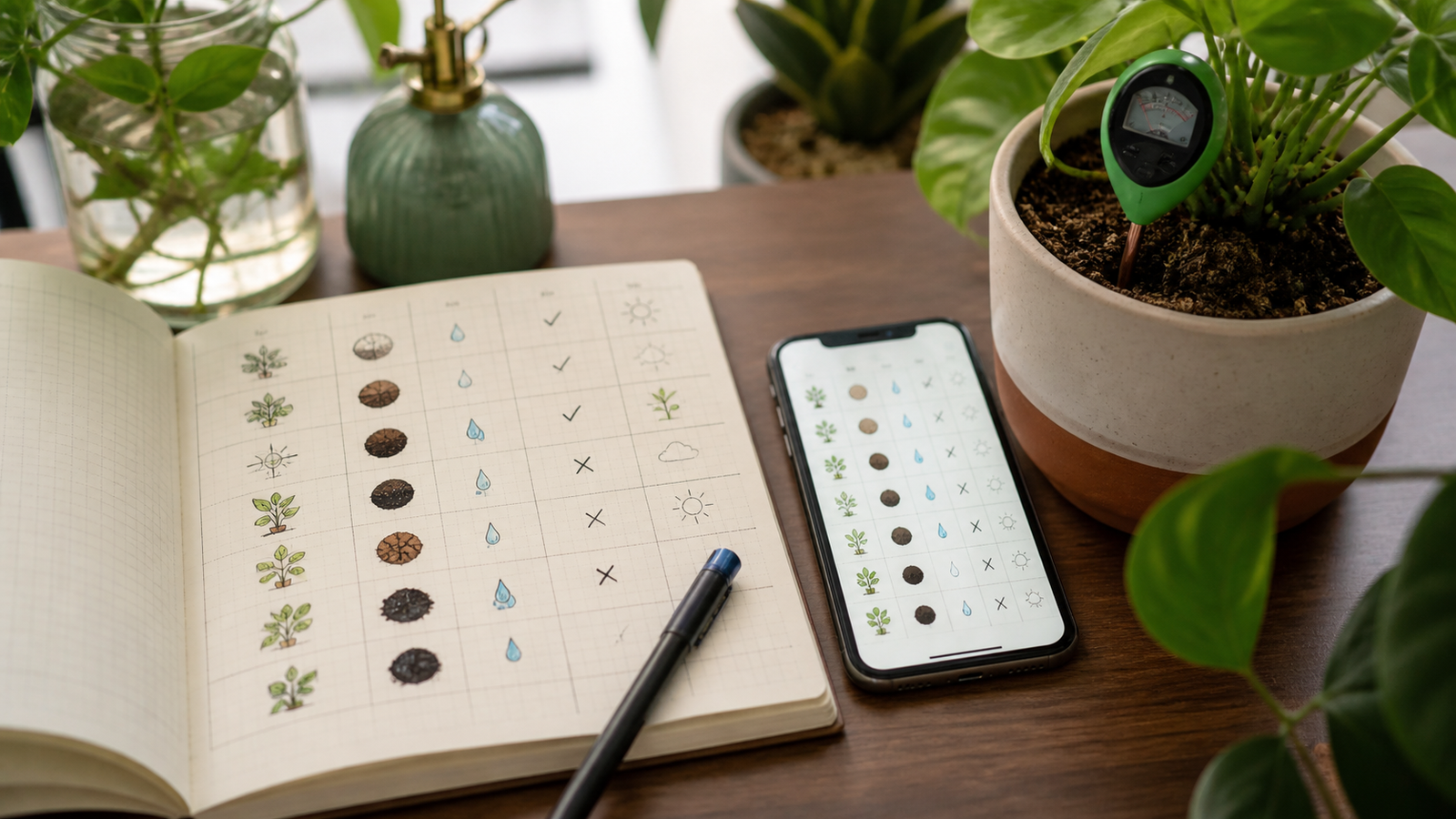
Keep this short enough that you will actually do it. Four things, thirty seconds.
- The date. Non-negotiable. Without it none of the rest computes into anything.
- Soil condition when you checked. Not necessarily a number from a meter — a consistent scale you invented and stick to works fine. Something like: soaked, damp at depth, dry top inch, dry two inches, bone dry and pulling from the pot edge. The scale does not need to be scientific. It needs to be the same words every time.
- Whether you actually watered. This is the field people skip, and it is the most valuable one. Logging a check where you decided not to water is what turns the record into evidence about drying speed. If you only log waterings, you learn nothing about the days you correctly held off.
- How much. Roughly. “Until it ran out the bottom” is a perfectly good entry, and better than a volume, because a thorough drench-and-drain is a different event from a splash.
That is the core. Everything below is optional and worth adding only if you have a specific question you are trying to answer.
The optional fields that earn their keep
Fertilizer. Date and what you used. Fertilizer is easy to double up on by accident, and salt buildup in the soil produces browning leaf edges that get misread as low humidity or underwatering.
New growth. A one-line note when you spot a new leaf unfurling. This is the clearest signal that a plant has entered an active growth phase, which is exactly when its water demand rises. It is more reliable than the calendar month, because your indoor conditions are not the outdoors.
Problems, with the date they appeared. Yellowing, brown crispy tips, drooping, gnats, spotting. The date matters more than the description, because the useful question later is “what changed in the two weeks before this started?” — and you can only answer that if both the symptom and the care events are timestamped.
Interventions. Moved to a brighter spot, repotted, started bottom watering, treated for pests. Change one thing at a time and note it, or you will never know which change helped.
How to read the log once you have a few months of it
The value is in the gaps, not the entries. Look at the number of days between waterings for one plant and watch how that number moves across the year. A plant whose gap stretches from a week to two weeks as the light drops is telling you plainly that its demand has fallen — and if you had held the weekly interval, you would have been giving it double what it wanted through the darkest months.
A few other patterns worth hunting for:
- Gaps that suddenly shorten. Either the plant has entered active growth, or it has become root-bound and there is less soil left to hold water. The repotting date in your record distinguishes these.
- A symptom that lines up with an intervention. Leaf drop starting a week after you moved a plant across the room is not a mystery, it is acclimation. Without the move logged, it looks random.
- Plants you check and skip repeatedly. If you keep finding a pot still damp, its real interval is much longer than you assumed, and it has probably been sitting wet for a long time.
- The plant you never log. Usually the one thriving on neglect. Worth knowing before you “fix” it.
| What the log shows | What it usually means | What to do |
|---|---|---|
| The gap stretches from one week to two | Less light, slower growth, lower demand | Follow the soil, not the old interval |
| The gap suddenly shortens | Active growth, or the plant is root-bound | Check the repotting date to tell which |
| You keep checking and finding it damp | The real interval is far longer than you assumed | Stop watering on schedule; it has been sitting wet |
| A symptom starts a week after a move | Acclimation to new light, not a mystery illness | Wait it out before changing anything else |
Keeping it somewhere you will actually look
A notebook works. A spreadsheet works. The main failure mode is any system that takes long enough to open that you stop opening it — the log only pays off if the entries are consistent over months, and consistency is mostly a function of friction.
A simpler way to keep a plant log
If you want this on your phone, Pocket Tables is an iPhone app for building small personal databases, and its plant care template gives you a starting set of fields you can add to or delete per table — so if you want a soil-condition scale in your own words and no fertilizer column, that is a two-minute edit. Worth being clear about the limits: it is iPhone only with no Android version, there is no team or multi-user mode, and it will not send you reminders on its own — checking the soil is still on you, which is arguably the point. There is no account to create and the data stays on the phone.
The habit that replaces the calendar
Keep the weekly walk-through. It is a good ritual and it gets you looking at your plants. Just change what happens at the end of it. Instead of watering everything, check everything, water only what needs it, and write down what you found — including the pots you left alone.
Within a couple of months you will stop needing to think about intervals at all. You will know that the terracotta pot in the south window is a five-day plant in summer and a twelve-day plant in winter, and that the one in the hallway is a “check it monthly and usually walk away” plant. That knowledge does not come from a schedule. It comes from a record.
Common questions
How often should I water my houseplants?
There is no single interval, and that is the point. Water when the soil says to, then record the date. After a few cycles the gaps between waterings tell you what that particular plant, in that particular spot, actually needs.
What should I record in a plant care log?
Four things per check: the date, the soil condition on a scale you invented and stick to, whether you actually watered, and roughly how much. Set up light, pot size, soil mix and location once per plant.
How do I tell overwatering from underwatering?
You often cannot from the leaves alone — both produce yellowing and drooping. The log is what separates them: if the gaps between waterings are short and the soil is usually still damp when you check, the problem is too much water, not too little.
Do I need a moisture meter?
No. A consistent scale in your own words works fine — soaked, damp at depth, dry top inch, dry two inches, bone dry. What matters is using the same words every time, not the precision of the measurement.
Why log a check where I did not water?
Because it is evidence about drying speed. A log of waterings only tells you what you did; logging the skips tells you what the plant needed, which is the thing you are trying to learn.