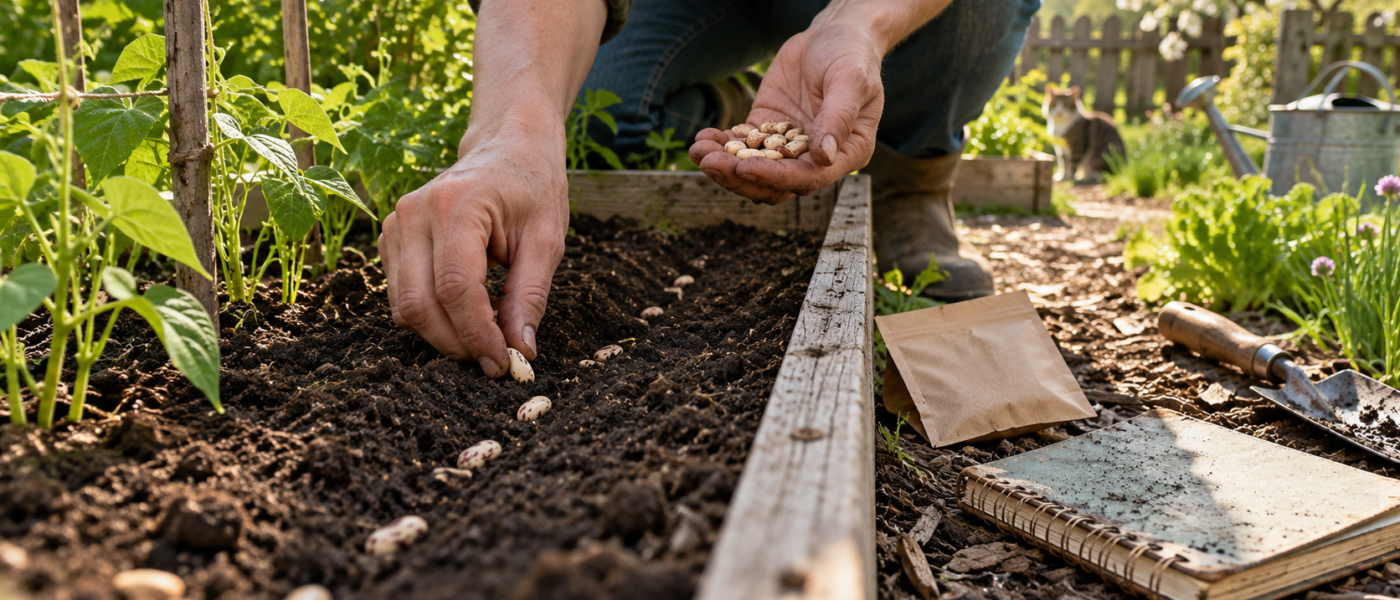
“Beautiful morning out there. Finally got the beans in, and the wren is back in the shed.” That is a lovely sentence and a completely useless record. Next February you will be standing over a seed order with one question in your head — which beans, and did they do anything — and that entry answers neither half of it.
Garden journals are usually written as diaries, and diaries are written to be read. Nobody rereads a garden diary. What people actually do, nine months later, is hunt through it for one date or one name, fail to find it, and go back to guessing. The journal didn’t fail because you stopped writing in April. It failed because even the entries you did write couldn’t answer the question you came back with.
A diary answers none of the questions you’ll have
An outdoor garden has a brutal property: you get one observation per year. One chance to see whether that squash was worth the space, one spring to notice the far end of the bed came up weeks behind the near end. Whatever you fail to capture, you wait a full year to see again.
The memory load is twelve months long, and memory is not. Ask yourself, in the dead of winter, what you actually want to know. It’s a short and repetitive list.
Which one was the good one? You grew three kinds of tomato. One of them was the one. You remember the fruit perfectly and the name not at all, because the name was on a packet that went in the recycling in May.
Where was it? Not “the garden.” Which bed, which end. A row that did nothing two years running in the same spot is telling you something; a row that did nothing in two different spots is telling you something else entirely.
When did I put it in, and when did it actually give me something? The gap between those two dates is the most practical thing a garden journal produces, and it is specific to your yard. Nothing printed on a packet will give it to you. Only your own record will.
Every one of those is a lookup. A diary is prose, and prose does not support lookups. The fix isn’t to write more; it’s to write differently.
The handful of events worth a row
You do not need a daily log. Most days in a garden produce nothing worth recording, and a format that expects an entry every day is a format you will abandon by the second rainy week.
What you need is an event log: one row each time something happens that you’ll want a date for. There are rarely more than four or five per plant across a whole season, and they’re the same ones every year.
| Event you log | What it answers a year later |
|---|---|
| Sown | Your own start date for this crop in this yard — the one you’ll either repeat or deliberately shift |
| Came up | Whether a packet is still worth using, and how long to wait before giving up on a row |
| Transplanted or planted out | How long things actually spent indoors or in pots before they went in the ground |
| First flower | An early read on whether this year is ahead of or behind last year, while you can still act on it |
| First harvest | The gap between going in and producing — the figure you’ll plan the whole season around |
| Done, pulled, or failed | How long the bed was occupied, and whether the ending was worth the space it took |
Six event types. For a garden with a dozen things, that’s a page of data for the whole year — less writing than two good diary entries.
Anything odd that doesn’t fit — hail, a deer, a week away — gets its own dated row. Those explain the strange gaps later.
Fields cheap enough to log with dirty hands
Here is the real constraint, and every other decision follows from it: you are logging while standing in a bed, holding a trowel, with about thirty seconds of patience. Anything slower won’t get logged — not because you’re lazy, but because you’ll tell yourself you’ll do it inside, and you won’t.
Five fields survive that test.
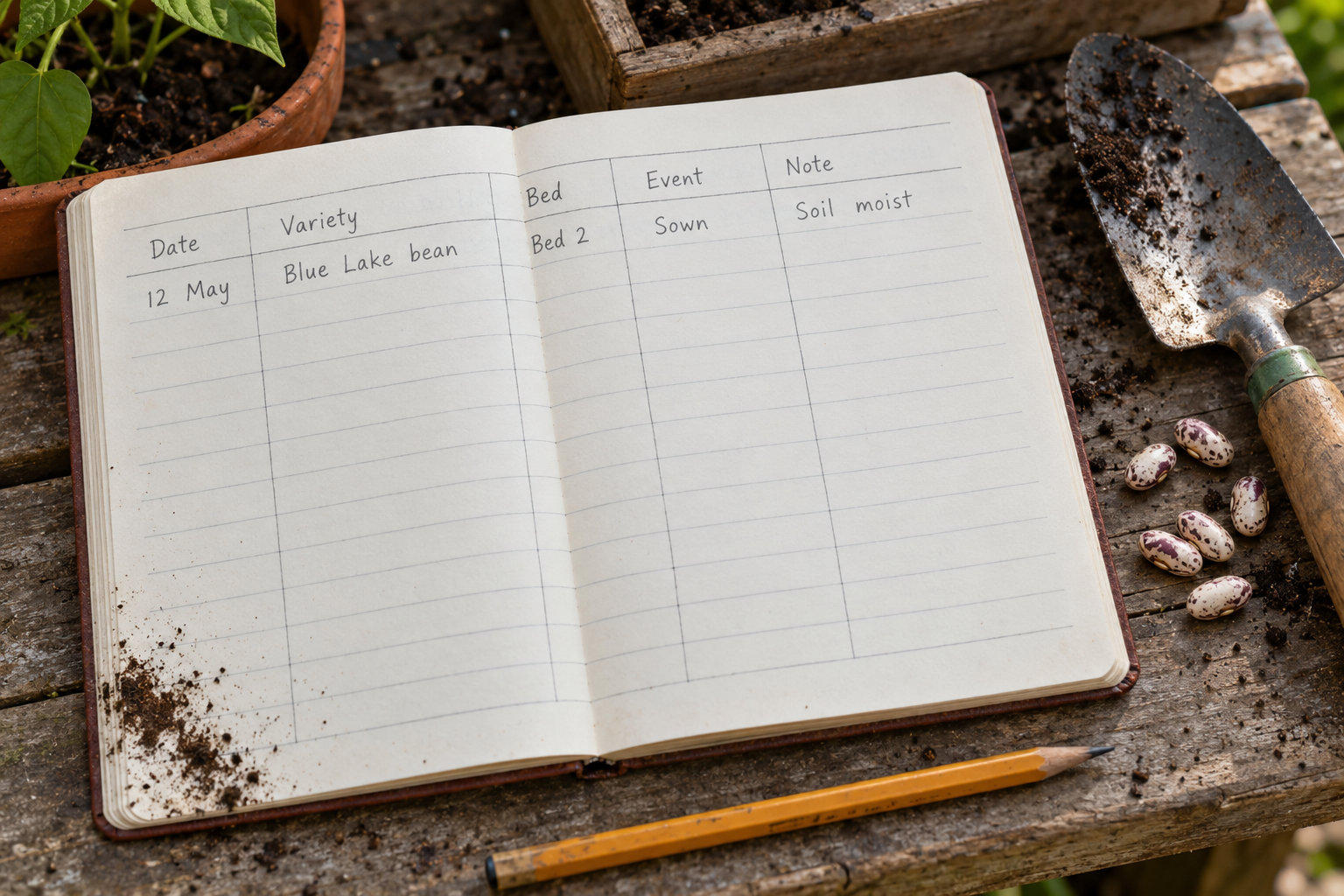
Date. Today, almost always. Should be a default, not a decision.
What. The full name as written on the packet or the label, not the category. “Tomato” is not an answer to the question you’ll ask in February. The variety name is the entire point, and it’s the field people skip most often, because in June you are certain you’ll remember. Write it the long way once, at sowing; later rows just refer back to it.
Where. A bed name, a row number, a corner — whatever vocabulary you already use out loud. It needs to be consistent far more than it needs to be precise. “Back bed, north end” every single time beats a careful measurement you take once.
Event. One of the six above, picked from a short list rather than typed. It should be a pick-list because free text drifts: sown, seeded, planted and put in all mean the same thing and none of them will group together.
Note. Optional, short, in your own words. “Ends of the row did nothing.” “Soaked all week.” “Second sowing, first one never came up.” Ten words from your past self beats any structured field you could have designed instead.
Fields that look appealing and rarely earn their keep: quantities, exact measurements, the supplier, the price, a daily weather column. The weather column is the trap: it demands an entry every day whether or not anything happened. The date is the thing worth capturing; the weather attaches itself to the date later.
The failures are the more valuable half
People record the wins. The basil was glorious, the first cucumber came in on a Thursday, there were more beans than anyone could eat. Those rows feel good to write.
The rows that change behavior are the ones about what didn’t work, and nobody writes those, because writing them down feels like filing a complaint against yourself. A row reading “never came up” is a small admission. It is also the row that tells you, next year, not to spend March waiting on the same spot.
The discipline is to record the observation and stop. What you saw, where, and when — not the diagnosis. A guess written in a confident tone becomes a fact you believe three years later. “Half the row came up, the rest never did” is a record. “The seed must have been old” is a theory, and it belongs in the note field with a question mark on it.
Log observations even when they seem meaningless. One year, “went to seed early” is noise. Three years in, the same note beside roughly the same date stops being noise. You can’t know which ones turn into patterns, which is the argument for making every one cheap to write.
“You’re not writing down what happened today. You’re writing down what you’ll wish you had known, for a version of yourself who is nine months away and holding a seed catalog.”
Where the record lives
The format matters less than the fields, but each option fails in its own way.
A paper notebook in the shed is the fastest thing in the world to write in and the worst to search. Nothing beats it for capture: no battery, no unlocking, no app, and muddy gloves are no obstacle. But the question you’ll have next February — show me every row for that one variety — means flipping through nine months of pages. Some people capture on paper and copy it into something sortable once a month, which works right up until the month they skip.
Photos are the most honest capture there is and the least usable index. A camera roll holding four hundred pictures of the same three beds carries no names. A fine supplement to a dated row, a poor replacement for one.
A notes app is a diary with a search box: fine for a first season, useless the moment you want to filter.
A spreadsheet is the natural fit for an event log: it sorts, filters and groups by variety without complaint. The problem is physical. Nobody enters a row into a spreadsheet while crouched over a bed, so entry gets deferred to the evening, and deferred entry is lost entry.
A database-style app on your phone splits the difference. You define the columns, the phone is already in your pocket, and a pick-list makes a row a few taps rather than a typing exercise. Everything is still typed by hand.
If you’d rather own the columns
Date, plant, location, event and note is close to what the plant care template sets up, and you’d reshape it from there — add a variety field, delete whatever you don’t use. Pocket Tables is an iPhone app that’s really a flexible personal database: there’s no account and the data stays on the phone. Be clear on the limits before you commit a season to it. Every row is typed in by hand, and it won’t identify plants, look varieties up, pull in weather, send reminders, sync between devices, share a table with anyone else, or run on Android. If you want plant identification and seasonal prompts, a dedicated gardening app is the more convenient tool. This is for people who want their own dates in their own columns.
The journal only pays off in its second year
This is worth being honest about, because it’s why most garden journals die in their first August. Year one gives almost nothing back: you log dates and failures all season, and the return on each row is zero until the following spring.
Then February arrives, you open it with an actual question, and the thing changes character. You sort by variety and there are the three tomatoes with dates attached to each, one of them clearly ahead. You sort by location and the back bed’s bad luck turns out to be two years old. You filter to “failed” and get a short list that is, functionally, next year’s plan.
That delay is the whole argument for keeping the fields cheap. A journal costing thirty seconds a row survives a payoff nine months out. One costing ten minutes of reflective writing will not, however good your intentions in March — you’ll quietly stop in week three and not notice.
Two habits carry it across the gap. Log in the moment, in the garden, with the dirty hands — never “later, inside.” Then run one end-of-season review, reading the year’s rows while they still mean something and writing a single summary row per plant: do again, don’t bother, try somewhere else. That summary is what you’ll open in February; the detailed rows are what you check when it surprises you.
Anyone looking up how to keep a garden journal is usually after a template to fill in. The template is the easy part. The hard part is designing it so the second year’s version of you — the only person who ever benefits — finds something sortable waiting.
Common questions
How often should I write in a garden journal?
Only when something happens. A daily entry requirement kills most journals, because most days genuinely have nothing to record and the empty obligation builds until you stop opening it. An event log skips those days without guilt — a busy week might produce six rows and a quiet one none.
Should I record the weather?
Not as a daily column. Historical weather for a given date can be retrieved after the fact; a sowing date you never wrote down is gone for good. Capture the dates and let the weather attach itself to them later. The exception is a short note in the moment: “first real heat of the year,” “hail overnight.”
Paper notebook or phone?
It depends on which half you’re worse at. If you never remember to write anything down, paper in the shed wins, because it removes every barrier between noticing and recording. If you write faithfully but can never find anything afterward, go with something sortable on the phone. The hybrid tends to collapse at the first skipped month.
Do I need a map of the garden as well?
A consistent location field does most of what a map does, without needing to be redrawn every year. If you want the picture too, one dated photo of each bed at its fullest, filed alongside the rows, is the cheapest version. What matters is that the names never change.
I’m starting halfway through the season. Is it worth it?
Yes, and it’s the normal way people start. Log from today forward and backfill only the dates you’re sure of, marking anything approximate as approximate — a confidently wrong date is worse than a blank. Half a season of real rows, plus a few variety names rescued from the packet drawer, is a good foundation for next year.