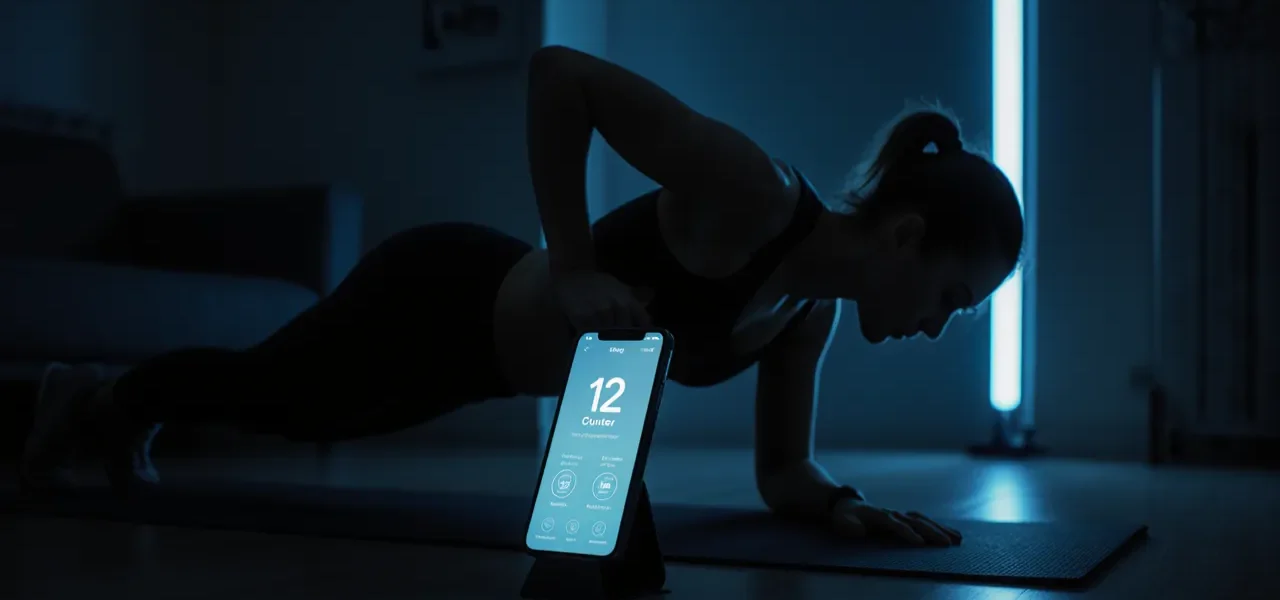
You’re ten push-ups in. Or was it eleven? You pause, lose your breath rhythm, start over. The set ends and you genuinely don’t know if you hit your target — so you round down, call it done, and feel vaguely cheated by your own workout.
This is one of those small, invisible frustrations that nobody talks about in fitness content. Everyone discusses programming, nutrition, progressive overload. Nobody mentions the sheer cognitive annoyance of counting reps in your head while also trying to maintain form, breathe properly, and push through fatigue.
It sounds trivial. It isn’t. And the solution sitting in your pocket is more interesting than you’d think.
The Hidden Cognitive Tax of Counting Reps
Research in cognitive psychology calls it dual-task interference — when your brain is asked to do two things simultaneously that compete for the same mental resources, both tasks suffer. Counting is a linguistic, sequential mental task. Physical exercise requires proprioceptive attention — awareness of your body position, breathing pattern, and muscular engagement.
When you combine them, neither gets your full attention.
- Your form degrades subtly as your focus shifts to the count
- You tend to speed up reps to “get through” the number faster
- You lose count around the point of peak fatigue — exactly when focus is hardest
- You either cheat yourself (undercounting) or add imaginary reps (overcounting)
None of this means your workouts are ruined by manual counting. But it does mean there’s real, measurable value in offloading that job to something else.
How AI Rep Counting Actually Works
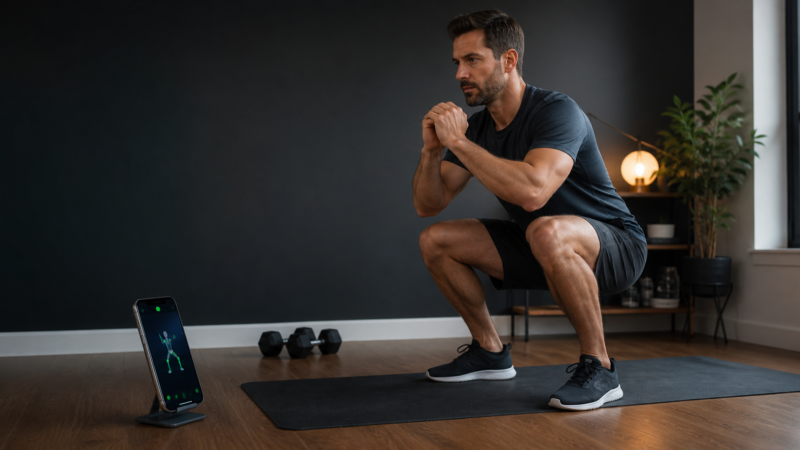
The premise sounds gimmicky until you understand the mechanics. Modern on-device AI uses your iPhone’s camera to perform real-time pose estimation — it tracks the positions of key skeletal landmarks (shoulders, elbows, hips, knees) across frames, detects the characteristic motion arc of a push-up or squat, and counts a completed rep when the full range of motion is completed.
It doesn’t guess. It watches the geometry of your movement.
What It Can Track
- Push-ups — detects the elbow angle reaching its minimum at the bottom position
- Sit-ups — tracks torso elevation from floor to upright
- Squats — monitors hip descent and return to standing
The processing happens on-device. Your camera feed never leaves your phone — there’s no server receiving footage of you exercising at 6am in your living room. That matters both for privacy and for latency; the count updates in real time without a network round-trip.
“The best workout tracker is the one that disappears into the background and lets you just train.”
AI-powered fitness apps on iPhone like RepCounta AI take this approach — propping your phone in front of you and letting the camera do the administrative work so your brain can focus entirely on the physical task.
The Consistency Problem Is the Real Problem
Most people who stop working out don’t stop because they’re lazy or lack willpower. They stop because the feedback loop breaks.
You miss one day. Then another. Two weeks later you’re not sure how long it’s been. The habit lost its shape. Without any record of what you were doing, there’s no psychological anchor pulling you back.
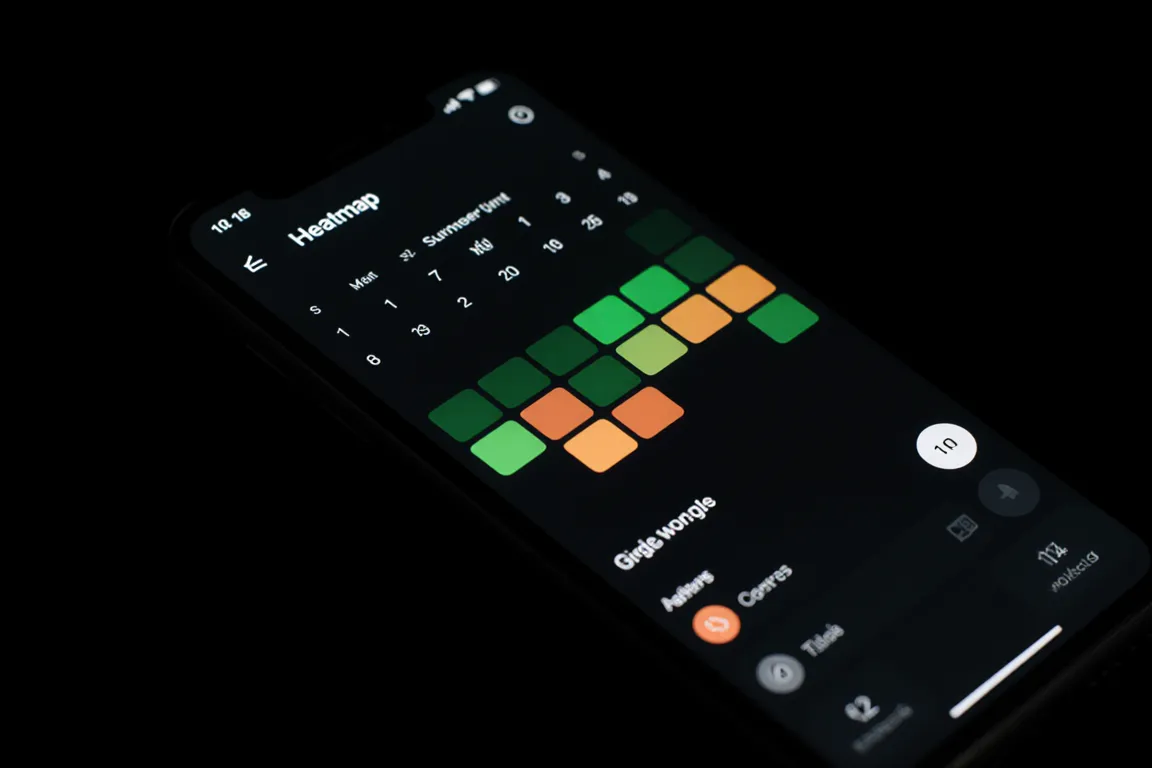
This is where the heatmap feature in AI workout tracker apps becomes surprisingly powerful. A heatmap of your workout consistency — green squares for active days, empty squares for missed ones — does something subtle to your psychology:
- It makes your streak visible, which activates loss aversion (you don’t want to break the chain)
- It shows gaps honestly, which removes the self-deception that “I’ve been pretty consistent lately”
- It turns a personal habit into something that looks like data — and data feels more real than memory
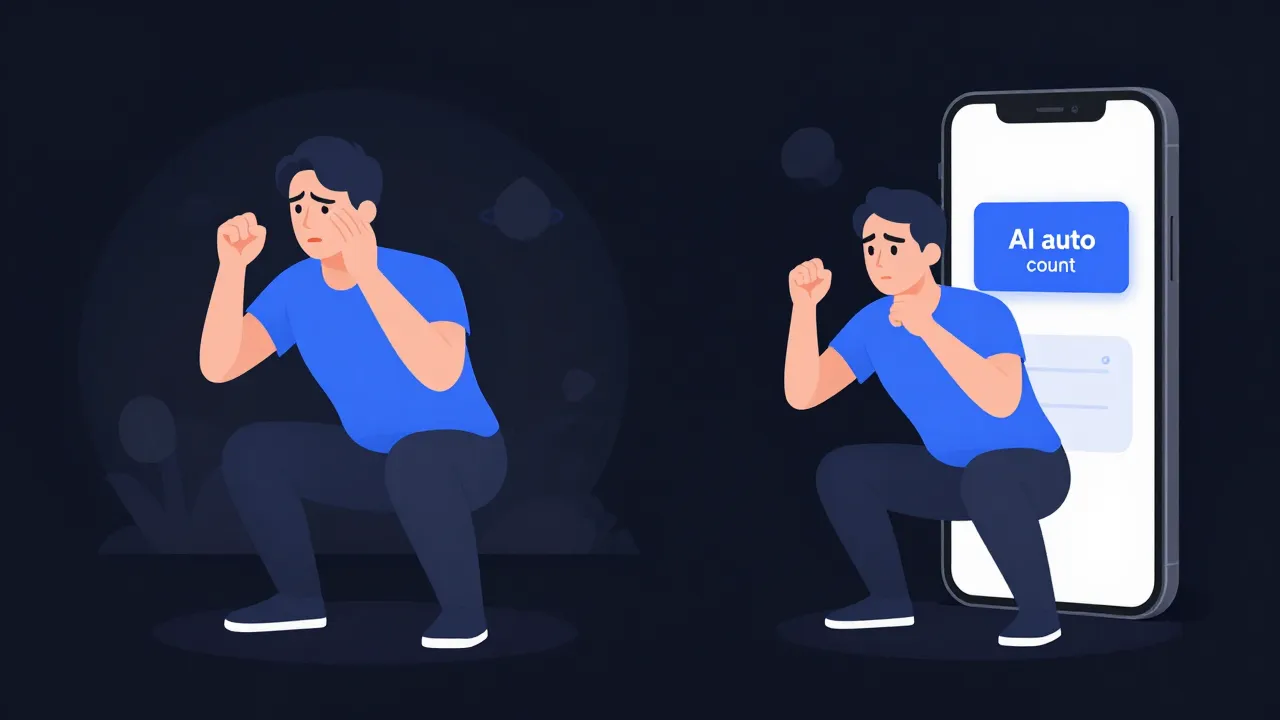
Manual Counting vs. AI Counting: An Honest Comparison
| Factor | Manual Counting | AI Counting |
|---|---|---|
| Cognitive load | High (splits attention) | Zero |
| Accuracy | Degrades with fatigue | Consistent regardless of tiredness |
| Historical record | Relies on memory or manual logging | Automatic, visual history |
| Form feedback | None | Camera-based posture detection |
| Consistency motivation | Relies on willpower alone | Visual streak / heatmap reinforcement |
Building a No-Excuses Home Workout Habit
The research on habit formation is clear: friction is the enemy of consistency. Every extra step between you and the habit is a door through which motivation can escape.
A practical framework that works for bodyweight training specifically:
- Pick three exercises only. Push-ups, squats, sit-ups. That’s it. Complexity kills follow-through.
- Set a fixed time. Not “when I have time” but “7:15am, before I open my phone.”
- Start with embarrassingly small targets. Ten push-ups. Five minutes. The goal isn’t the number — it’s the habit groove.
- Use your camera as a witness. Prop your phone, start the session, let the AI count. You’re now accountable to a record.
- Review the heatmap weekly. Not daily — that creates anxiety. Weekly gives you signal without noise.
The “I Don’t Have Equipment” Problem
One underrated benefit of AI rep counting for bodyweight exercises specifically: it legitimizes the workout.
There’s a persistent psychological bias where workouts without equipment feel “less real” than gym sessions. If you’re doing push-ups in your bedroom, some part of your brain doesn’t fully count it. You don’t log it. You don’t remember it clearly. It evaporates.
When your phone is tracking it — recording the exact rep count, timestamping the session, adding a square to your heatmap — the session becomes real. It happened. The data says so. That shift from invisible effort to recorded effort changes how you value your own consistency.
This is the same psychological mechanism that makes step counters work. People who track their steps walk more — not because the tracking itself adds steps, but because visibility changes behavior. Research from Stanford confirmed that self-monitoring interventions reliably increase physical activity levels across populations.
Frequently Asked Questions
Does AI rep counting work in low light or at night?
Camera-based pose estimation requires reasonable lighting to accurately track skeletal landmarks. Most AI fitness apps, including on-device solutions, work well in standard indoor lighting but may lose accuracy in dim conditions. For evening workouts, a simple desk lamp aimed at your exercise space is enough.
Is my camera footage stored or sent to any server?
With on-device AI apps, the camera feed is processed locally on your iPhone and never leaves the device. No video is recorded or transmitted. The app uses real-time pose estimation frames — it sees movement patterns, not stored footage. Always check an app’s privacy policy to confirm this, but genuinely on-device solutions do not upload your camera data.
What’s the ideal phone placement for accurate rep counting?
Position your iPhone 1.5–2 meters away at roughly chest height, angled so your full body is visible in frame. For push-ups, a side-angle view works best. For squats and sit-ups, a frontal or slight side angle captures the full range of motion. Most AI fitness apps provide on-screen guidance for optimal placement.
Can AI rep counters detect partial or poor-form reps?
Yes — this is one of the underrated benefits. Because the AI tracks the actual range of motion (not just a body in motion), it typically only counts a rep when the full movement arc is completed. A half-rep push-up where you don’t reach full elbow extension often won’t register. This creates an honest record that manual counting rarely provides.
Is this only useful for beginners, or do experienced athletes benefit too?
Both. Beginners benefit from the reduced mental overhead and the accountability of a recorded session. Experienced athletes benefit from the longitudinal data — being able to look at months of workout history and spot patterns in volume, frequency, and consistency is something that was previously only accessible through manual journaling or gym software.
A simpler way to track your home workouts
If you want to try camera-based rep counting without connecting to a cloud service or sharing your workout data, RepCounta AI for iPhone does exactly this — it uses your device’s camera to count push-ups, sit-ups, and squats locally, and generates a heatmap of your workout consistency over time. Worth trying as a low-friction way to make your home sessions feel more real.