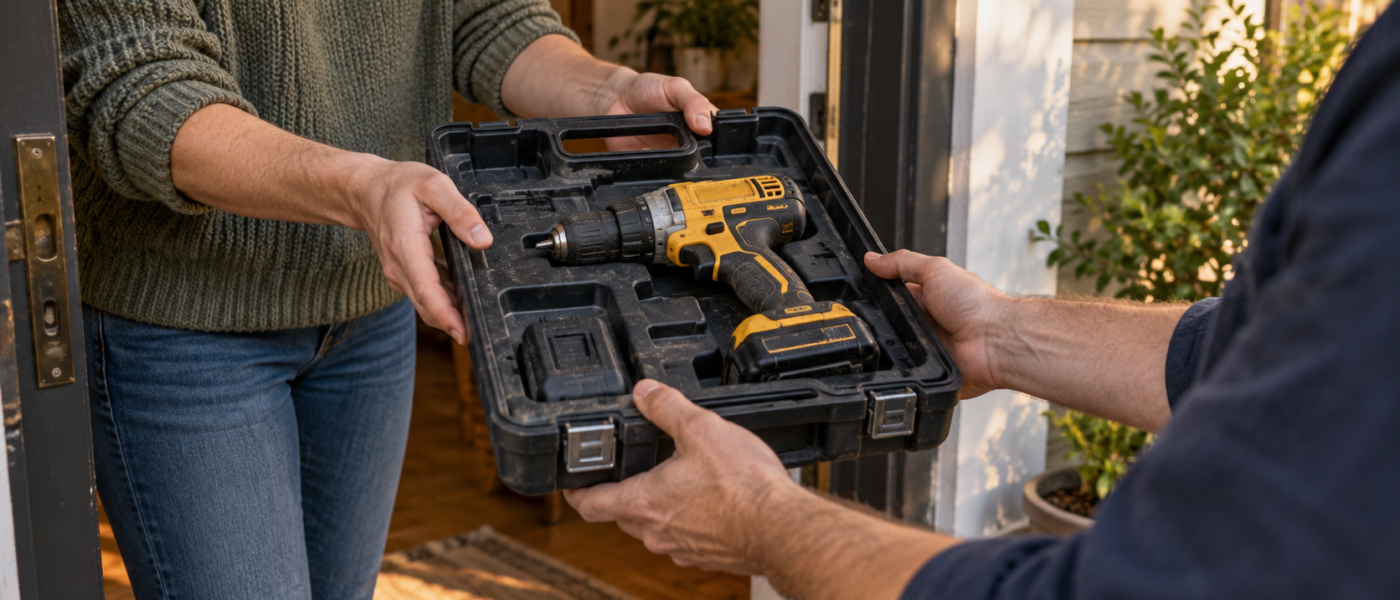
You do not forget the drill. You remember buying it, you remember the weekend you finally needed it, and you remember someone asking whether they could take it for a couple of days. What goes missing is one word: the name. Was it the friend redoing his deck, or the neighbor with the fence problem? You have a vivid memory of the object and a blank space where the person should be.
That asymmetry is the entire problem, and it is why most advice about lending aims at the wrong target. This is not a memory problem about things. It is a memory problem about pairs — thing plus person — and the pair decays much faster than either half.
Why writing it down feels like distrust
Almost everyone has the same reaction to logging a loan: it feels like keeping a ledger against your friends. You hand someone a hedge trimmer and then open an app to make an entry about them. It reads as suspicion — and suspicion is not what you feel. You just know that a year from now you will not be able to name who has it.
Flip it around. Two things go wrong without a record, and both are worse than an entry nobody sees. The first is asking the wrong person. “Hey, do you still have my circular saw?” to someone who never borrowed it is an accusation with no target, and it lands as one even when you are smiling. The second is that you stop asking at all, because you are not sure enough to risk it — so the item is gone, and a low-grade suspicion attaches itself to whoever you half-remember. That is heavier to carry than a line of text.
The record also has a property that makes the objection evaporate: it is invisible. It lives on your phone, nobody is shown it, nothing about the handover changes. You are not producing a form in the doorway. You are doing what you do when you add milk to a shopping list, and for the same reason — because you will not remember, and remembering is not a character trait.
Four fields, ten seconds, at the door
So the question is not whether to keep a record but how small it can be. The entry happens in the worst possible conditions: a doorway, something bulky in one hand, mid-conversation, the other person halfway to their car. If it takes thirty seconds and five decisions, you will not do it. You will tell yourself later, and later does not come.
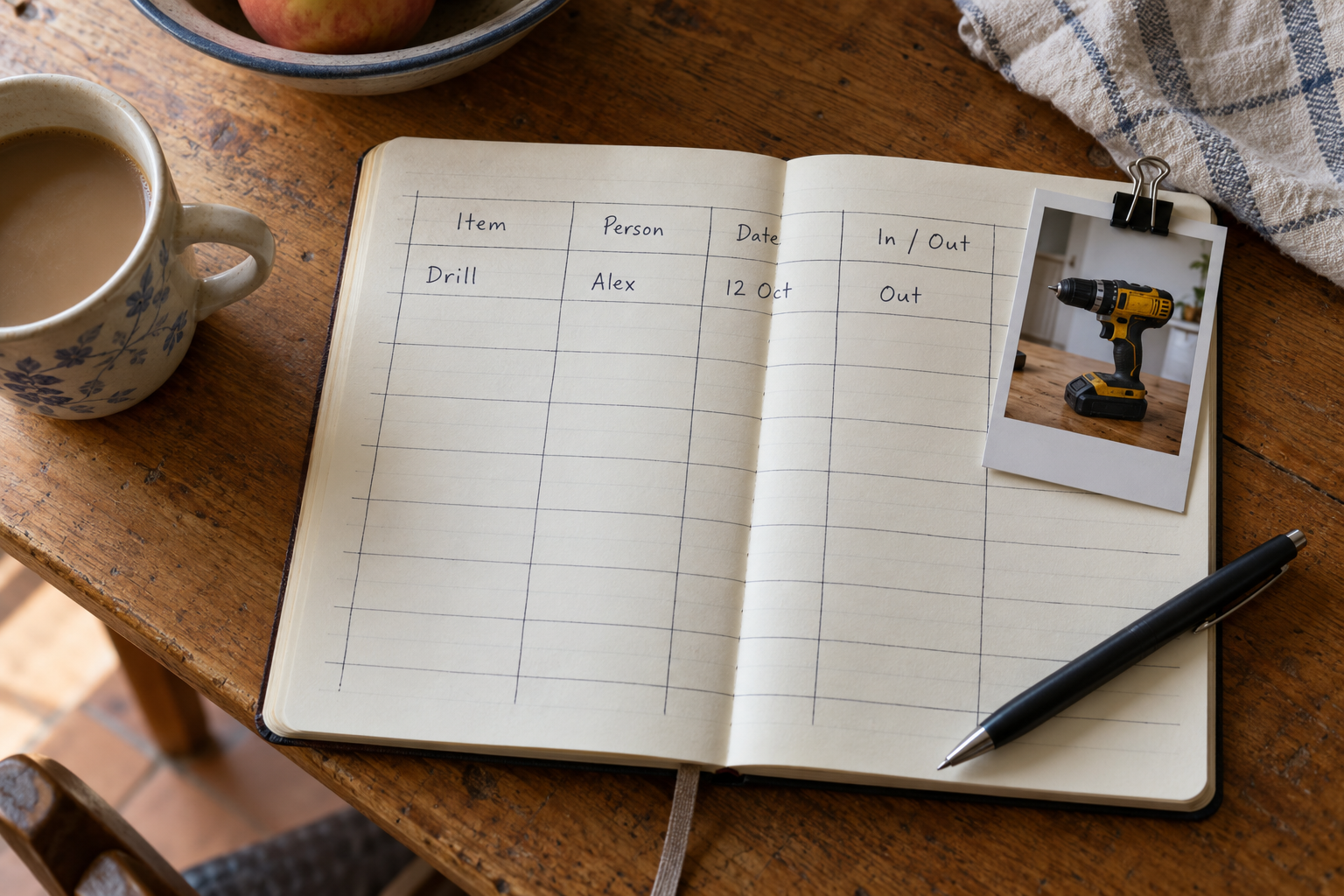
So the record is four fields, and nothing else until the thing comes back.
The item. Specific enough that you would recognize it six months from now. “Drill” is weak if you own two. “Yellow cordless drill, with the case” is a row you can act on.
The person. The field the whole system exists for. A first name is usually enough; add a qualifier if you know two people with that name, because “Sarah” ages badly.
The date it went out. Not a date it is due back. Just the day it left. This number does more work than anything else in the table, and the next section is about why.
A photo, taken at handover. This is the cheapest field in the system and the one people skip. You are already holding the thing. One shot — in their hands, on their passenger seat, on the hall floor — takes two seconds and records the item, its condition on the day, and very often the person, all at once. If you adopt one habit from this article, make it this one.
That is the complete list. Resist value, category, condition ratings, long notes, anything that asks you to think. Every extra field is one more reason to postpone the entry, and a postponed entry is no entry.
The direction nobody tracks
Every article about lending covers the things you lend. Almost none cover the things you borrow, which is strange, because that is the direction that actually embarrasses you.
The reason is a quiet asymmetry in confidence. When you lend something, you know you will want it back, so part of you stays alert. When you borrow something, you are certain you will return it — obviously you will, it is right there — and that certainty is what stops you writing it down. Then the item stops being a visitor. The borrowed book moves onto the shelf beside your own. The camping stove goes into the garage with your camping gear. The casserole dish gets washed and put away in your cupboard, which is the moment it is effectively lost, because nothing in your house will ever flag it again.

Meanwhile the person who lent it to you remembers perfectly well. They are just not going to mention it.
“Nobody is embarrassed by the drill they lent out. They are embarrassed by the one sitting on their own shelf that they cannot remember borrowing.”
The fix is not a second system. It is one more field on the same record: direction. Out or in. One tap, and a single table answers both questions — what is out in the world, and what in your house belongs to someone else.
The payoff differs by direction. An out row tells you who to ask. An in row tells you what to carry to the car when you are going to see someone anyway — a vague background obligation turned into a one-line errand.
Why a due-back date is the wrong field
The instinct, once you have a date, is to add a second one: when it should come back. It feels responsible. It is almost always wrong.
Due dates work for a library because a library has a published policy and no relationship with you. Personal lending has neither. You invented the date, the borrower never agreed to it, and often it was never spoken aloud. When that date arrives and your phone turns a row red, you are holding a deadline only one of you knows about — the exact awkwardness the record was supposed to prevent.
It is also a bad signal. A drill out for three weeks during someone’s renovation is fine. A paperback out for three weeks is fine. A folding table out for three weeks when you needed it last Saturday is not. Elapsed time means nothing on its own; what matters is you looking and judging. A date cannot do that, and when it pretends to, you learn to dismiss the alerts, which kills the habit.
What works instead is a view, not a field: sort by date out, oldest first. Nothing goes red, nothing pings. You glance at the top of the list now and then and notice the stand mixer has been gone since March. Sometimes that is fine and you close the app. Sometimes it is the prompt you needed. Either way the judgment stays with you.
The exception is small and real. Some loans have a genuine external deadline — a library book you passed on, gear that has to go back to a rental counter. There the date is a fact rather than an opinion, and it is worth recording on those few rows. The mistake is making it a mandatory column.
| Field | Keep it? | Why |
|---|---|---|
| Date out | Yes | One tap, never wrong, and it powers the only view that matters |
| Due back date | Rarely | You invented it, the other person never agreed to it, and the alert is a demand nobody made |
| Photo at handover | Yes | Two seconds while the thing is in your hands; captures item, condition and often the person |
| Direction (out or in) | Yes | Turns one table into two answers and covers the side most people never record |
| Value or replacement cost | No | Nothing changes based on it, and it is the field that makes a memory aid feel like a ledger |
| Condition notes | No | The photo already did this, better than a sentence composed in a doorway |
Where the record lives
The test is not features. It is how many taps stand between your lock screen and a finished entry, because the entry is made while someone waits.
A notes app is the fastest thing you own and the most common answer. It handles four or five live loans well. What it cannot do is sort, so the oldest-first view — the one piece of real intelligence in the system — is unavailable, and once the list is long enough to scroll it stops being readable.
A photo album called “lent” is a clever hack, because the handover photo is already the richest part of the record. The gap is the name. Unless the person is in frame, the album tells you what left and when, and nothing about who — the one field you actually needed.
A spreadsheet sorts beautifully and costs nothing. It is also unpleasant to type into one-handed in a driveway. Plenty of people enter rows later from a desk, which works right up until the evening they forget.
A database-style app on the phone sits between the two: you define the columns, entry is phone-shaped, and you can sort by date out. Everything is typed by hand, which is the trade.
If you want the columns to be yours
Pocket Tables is an iPhone app that is really just a flexible personal database — you can build this five-column table in a couple of minutes, or start from something close in the template library and delete what you do not want. Being straight about the limits: every row is typed in by hand, Pocket Tables will not remind you about anything or send notifications, there is no sync, no sharing, no account, and no Android version — the data just sits on the phone. Keep the handover photos in your camera roll and let the table carry the words. If you want a tool that chases people for you, this is not it.
Closing the loop when it comes back
The maintenance is one action: when the thing returns, delete the row. Not archive, not mark complete — delete. A list that fills with closed loans becomes a list you read past, and a list you read past is a list you stop opening. The value of this record is that it is short enough to take in at a glance.
There is one tempting addition worth refusing. You could keep returned items and build a picture of who gives things back promptly and who does not. But that is the single field that converts a memory aid into a judgment about people, and you will feel the difference the next time you hand something over. Delete the row instead.
The ongoing habit is about a minute long. Open the list, read the oldest three rows, decide whether any matter this month, close it. Do it when you think of it — a missed month costs nothing, because the dates are still sitting there.
One boundary worth stating: this is a record for objects. Money between friends is a different problem, and this table is not the tool for it.
Common questions
What is actually worth recording?
A rough test: would you buy a replacement if it never came back? If yes, log it. That covers tools, kitchen equipment, camping and sports gear, and books you care about. A spare charger from a drawer is not. The other thing worth logging regardless of price is anything part of a set, because a single missing piece quietly ruins the rest.
Should I tell people I keep a list?
There is no need to announce it and no need to hide it. It is the same kind of object as a shopping list — a note you wrote because your memory is ordinary. Most people never notice the photo, and the ones who do generally think it is sensible.
Do things I borrow need a separate table?
No, and separating them is usually a mistake. One table with a direction field gives you both views from one place, and the borrowed rows are the ones you will neglect if they live somewhere you have to remember to open. If the list feels cluttered, filter rather than split.
What about things that are already out?
Write down what you can name with confidence and leave the rest. Scrolling back through your camera roll around the time you think something left occasionally recovers a name. Beyond that, starting the record today is worth more than reconstructing last year.
What about one person who borrows often?
Keep one row per item, not one per person. Three rows tell you what is out; a row that says “various” tells you nothing, and merged rows are the first to drift out of date. If the same two or three items circulate constantly between the same houses, those are arguably shared possessions — stop logging them and save the record for everything else.