
Almost everyone starts a catalogue the same way: pick up the first item, and try to write down what it is. Forty minutes later there is one item in the list, eleven columns at the top of the sheet, four of them already awkward to fill, and two hundred and ninety-nine objects still sitting on the shelf. The second session never happens.
The failure isn’t laziness or the wrong app. It’s the direction. Describing an object completely is unbounded work — there’s always another attribute, and nothing in the object tells you which ones matter. A collection, by contrast, generates a very small number of questions, and questions have ends.
The three questions a collection generates
It doesn’t much matter what the collection is. Records, hand tools, houseplants, board games, camera bodies and lenses — the moments that make someone reach for a list are the same three, and they tend to arrive in this order.
Do I already have this one? You’re standing in a shop, or a listing is open in a tab, and you cannot remember. This is the question that costs money when it goes unanswered, and it’s the one people most often discover they have been getting wrong for years.
Where is it? You know you own the thing. It is not where you expect. It may be in a box, in a different room, or with a friend who borrowed it in March.
What did it cost me? Usually asked long after the fact, and almost always unanswerable, because the receipt is gone and the memory is generous.
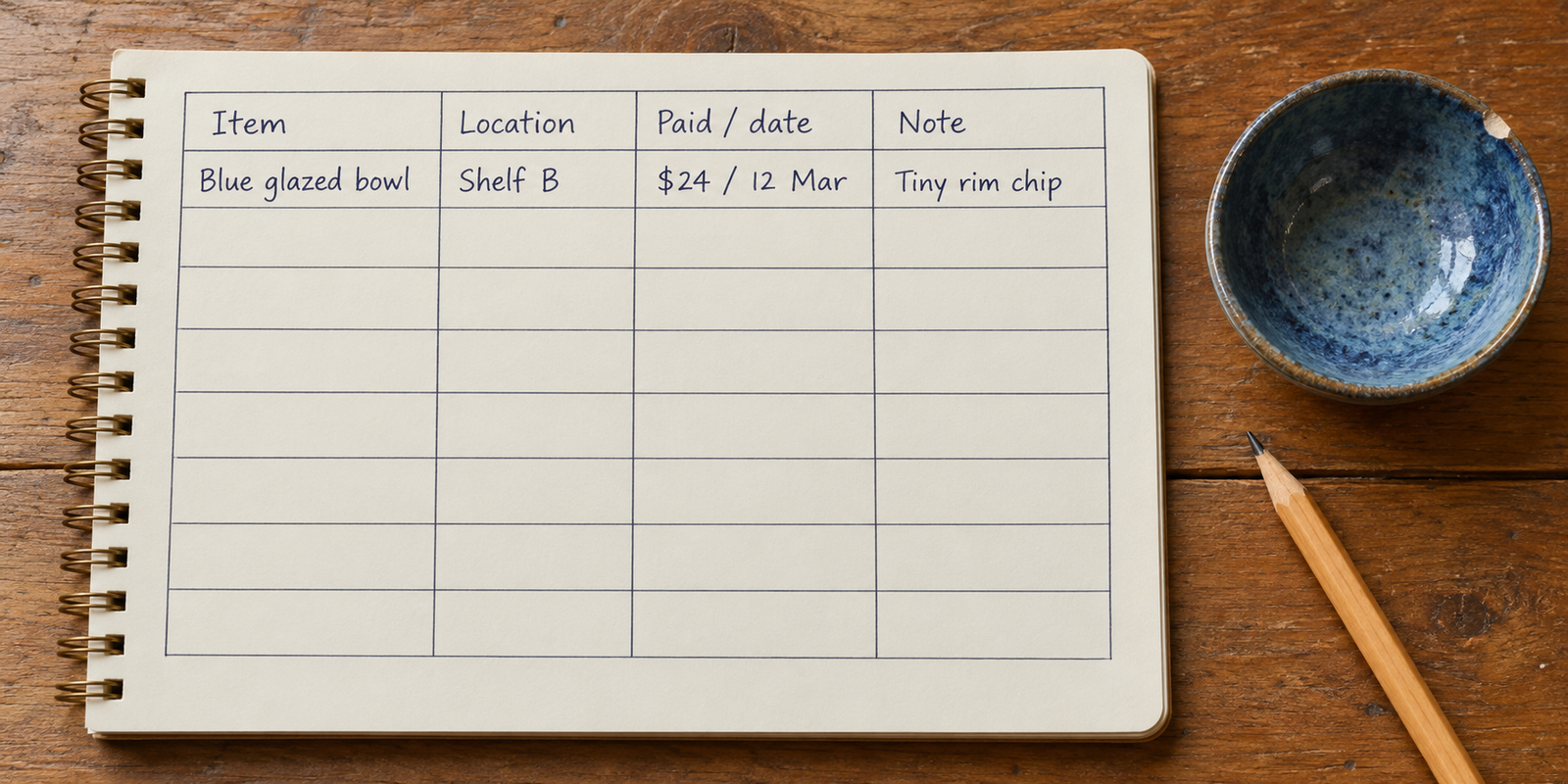
Three questions, three fields, plus somewhere to write a sentence. That’s a catalogue you can design in about five minutes.
| The question you actually have | The field that answers it, and what goes in it |
|---|---|
| “Do I already have this one?” | A name precise enough that two near-identical things can’t be confused — artist, title and pressing; brand, model and size; species and cultivar |
| “Where did I put it?” | Location, in the words you’d actually say out loud: “shelf B,” “garage pegboard,” “south window,” “lent to Dana” |
| “What did I pay for this?” | Price paid and the date paid, copied as it appeared, not reconstructed from memory |
| “How many of these do I have?” | Quantity — on the rows where individual items don’t need separate identities |
| “Is this one still mine?” | Status: kept, sold, given away, broken, dead — which is better than deleting the row |
| “What’s the thing I keep forgetting about this one?” | A free-text note in your own words — the most skipped field in any catalogue, and the one people miss most |
The first question is the one that quietly sets the size of the whole job, because it decides how precisely you have to name things. Two copies of the same album from different pressings are two items to one collector and one item to someone who only wants to know whether the album is on the shelf. A 10mm socket is just a 10mm socket until you own three sets and start caring which set is missing one. Monstera is enough until the day you own two and one of them is the variegated one you paid real money for.
The rule that saves the most time: name things precisely enough to answer the duplicate question, and no more precisely than that. If you cannot picture yourself standing somewhere, genuinely unsure which one you own, the extra detail is costing you typing and buying you nothing.
The same logic runs the other way. Parts of a collection don’t need rows at all: sixty identical plant labels are one row with a number in it, and a bag of unsorted dice is one row called “loose dice, cupboard.” If there’s no decision attached to an individual unit, it doesn’t get an individual line.
How a fourth field earns its place
Everything after those three is where catalogues go to die, because a fourth field always sounds reasonable in the abstract. Of course you should record the year. Of course the maker. Then you have nine columns, you’re filling in four of them, and opening the thing feels like paperwork.
The test is narrow on purpose: has this question actually come out of your mouth? Not could it, not would a serious collector. Have you had it.
Run that test across different collections and the answers genuinely differ, which is the point:
Board games earn a player count and a playing time immediately, because that question gets asked out loud every time people come over and someone says “what can five of us finish before eleven?” Nobody has ever needed the publisher.
Houseplants earn a date — last repotted, last fed, whichever thing you keep getting wrong — and a light-and-position note. The Latin binomial is fine to have and answers nothing you’ve asked.
Hand tools earn a lending field, because “where is it” has a second answer, and the second answer is “with someone,” and that someone will not remember either.
Camera gear earns serial numbers, for the specific and boring reason that serial numbers are what repair shops and insurers ask for. If nobody has ever asked you for one, skip it.
Records earn a catalogue number, because in a shop that’s the only thing that reliably distinguishes the copy in your hand from the copy at home.
Five collections of similar size, five different fourth fields. A field list copied from someone else’s hobby is how you end up maintaining their questions instead of your own.
“Three fields are a catalogue. The fourth one has to be a question you’ve actually asked out loud — not one you can imagine a more serious version of yourself asking.”
What you paid, and nothing past it
The cost question is where catalogues quietly turn into fiction, so it’s worth being strict about one distinction.
Two things belong in a money column. The first is what you paid and the date, copied from the receipt, the order email or the bank line while it still exists — a fact about your own history that nothing erodes. The second, optionally, is a figure from somewhere specific, recorded as a quotation: the number, its source, and the day you looked. “Asked $90, dealer at the fairgrounds, 14 March” is information, because it has an owner and a date and you can tell later how much weight to give it.
What does not belong is a number you arrived at yourself. The moment a column implies the catalogue knows what something is worth, you’ve built a machine for turning your own guesses into facts — because future you reads the column heading, not the reasoning behind it. This article isn’t going to tell you what anything in your collection is worth, and neither is your spreadsheet.
There’s one plain, practical reason to keep the paid-and-dated fields tidy anyway: if the collection ever comes up with an insurer, they will ask for a list. What they want on that list, and what they do with it, is a conversation to have with them. The catalogue’s only job is to exist, and to be honest about where each number came from.
The rough first pass, and keeping it true
However you decide to catalogue a collection, do the first pass badly, deliberately. Go in physical order — shelf by shelf, drawer by drawer, pot by pot — and type a short name and a location. Nothing else. Names you’d recognise in six months, so “blue Le Creuset 24cm” rather than “pot.”
Two hundred items, names and locations only, is one evening with something on in the background. The same two hundred with photographs, measurements, provenance and condition grades is a project, and you will stop in the second hour. A half-finished catalogue is worse than none — you’ll trust it right up to the moment it tells you that you don’t own something you own.
Fill the optional columns opportunistically after that: a price when a receipt surfaces, a note the day an item annoys you. The catalogue gets richer exactly where you use it, which is the correct distribution of effort.
Then two habits keep it true. Add things at the moment of acquisition, before they reach the shelf, while the box and receipt are still in your hands — thirty seconds, and the highest-leverage habit there is. And record departures: sold, given away, broken, dead. Collections leak, and a list that only grows stops matching the room. If you care about having owned something, set the status and keep the row; if not, delete it. Either is fine; drifting is not.
Once a quarter, reconcile one shelf against the list — not the whole collection, one shelf, rotating. Ten minutes finds the drift, and shows you which category you keep forgetting to log.
Where the record lives
The fields matter more than the tool, but the tool decides whether the fields ever get filled in.
Dedicated collection managers are the best option when one exists for your exact domain. A record app knows what a pressing is; a board game app knows player counts; many can pull an item in from a barcode or catalogue number, which removes most of the typing. The trade is that you get the fields the designer chose. If your fourth field isn’t one of them, it goes in a notes box where you can’t sort by it.
A spreadsheet is free, sorts and filters beautifully, and handles any collection at all because you define the columns. It’s also miserable to type into while standing in a garage holding something. The common compromise is to enter at a desk and consult on a phone.
A notes app is genuinely fine up to about thirty items and stops working the instant you want to filter or sort.
General database-style apps sit in between: you define the fields, entry is phone-shaped, and you can filter by anything. Everything is typed by hand.
Which brings up the thing that sends most people to a spreadsheet. Plenty of collections have no dedicated app and never will — “interesting things from estate sales,” odd kitchen tools, whatever has accumulated in one particular cupboard. Nobody builds a manager for a category of one, so those collections need a tool where you bring the columns.
If nobody built an app for your collection
Pocket Tables is an iPhone app that’s really just a flexible personal database. You start from the collections template and then add or delete fields until the columns match the three questions your collection actually generates — no account, and the data stays on the phone. Being straight about the trade: every item is typed in by hand. Pocket Tables won’t scan a barcode, look anything up, fetch images, price anything, sync between devices or share a list with anyone, and there’s no Android version. If your collection sits squarely in a domain with a good dedicated manager, that manager is the more convenient tool. This is for the collections that fit nobody’s categories.
Common questions
How do I catalogue a collection that’s already large?
In physical order, with two fields, in one sitting, and then stop. Doing it properly from the start is what kills large-collection catalogues specifically: the finish line is far enough away that any added per-item effort turns into hours. Get names and locations down for everything, then enrich the rows you care about afterwards.
Should I photograph every item?
Only where a photograph answers a question you have: condition you’d want to compare later, variants that look alike on a shelf, things you lend out, a list someone has asked you for. Photographing everything on principle is the slowest possible first pass, and photos don’t help with sorting or spotting duplicates.
One table for everything, or one per collection?
Split by questions, not by objects. If two sets of things generate the same questions, one table with a type column handles both. If one needs a watering date and the other a player count, they’re two tables — forcing them together leaves half the columns blank on half the rows, which is how a list starts to feel broken.
What if I don’t know what I paid?
Leave it blank, or write “unknown.” A blank behaves correctly — it sorts to one end, averages into nothing, misleads nobody. A number reconstructed from a feeling about 2019 looks identical to a real one once it’s in the cell, and that’s the problem with it.
Do I need a condition field?
Only if you make decisions from it — what to repair, what to use rather than keep, what not to lend. Keep it in your own plain words (“chipped foot, stable”) rather than borrowing a grading scale you’d look up every time. Scales are for talking to other people; your catalogue is talking to you.