
Nearly every guide to starting a life list stops at the one thing every life list already has: the name of the bird. Write down what you saw, keep the names in order, watch the number climb. That isn’t a record. That’s a tally with nicer handwriting, and a tally is exactly what people are objecting to when they say a list turned their hobby into homework.
A life list is a dated record of firsts. The species name is the row’s label, not its contents. What makes a list worth opening ten years later is the two or three small fields around the name — when, where, and one line about what was actually going on that morning — because those are the parts you can’t reconstruct later, and the name is the part you were never going to forget anyway.
Why a column of names goes flat
The first dozen entries don’t need help. You remember them whole — the weather, who you were with, the absurd thing that happened on the walk back. You add them to the list almost as a formality, because the memory is already vivid and the list is just where you put it.
Somewhere past the first hundred rows, that stops being true. The entries from three years ago are names with years next to them. You know you saw the bird; you have no idea where you were standing, or why that one took you four separate attempts. The list preserved the least perishable piece of information and discarded everything that was going to fade.
Worse, a names-only list gives you nothing to do with it. It supports exactly one operation — counting — which is how a list starts to feel like a scoreboard. Not because lists are competitive by nature, but because a list with one usable column can only be used one way.
The fields that do the work
A life list that still reads well in a decade is a short record, not a long one. Four or five fields, every one of them filled in, beats twelve fields that are mostly blank.
The full date, not the year. A year is nearly useless; it tells you a sighting happened sometime across twelve months. A full date drops the row into a real timeline next to everything else you logged that week, which is often how you remember a trip in the first place — not by species, but by the three days you spent somewhere.
The place, at a precision you choose. For your own copy, as specific as you want. Birders differ considerably on how precise a location should be when it’s shared, and plenty of people deliberately keep certain sightings coarse — a county or a general area rather than a pin. Decide the convention once, apply it consistently, and note it in the list so a vague entry reads as deliberate rather than lazy.
Who you were with. Cheap to record, and it recovers the half of the memory that isn’t yours — including someone to ask when your own note is two illegible words.
The circumstance line. One sentence. This is the field that does more than all the others combined, and the next section is entirely about it.
How you counted it. Heard only, seen briefly, seen well, seen from a moving car, pointed out by someone else. Not because any of those is better than another, but because future-you will want to know which it was without having to guess.
| Field | What it saves you from |
|---|---|
| Full date | A list you can only read alphabetically, rather than as the sequence of mornings it was |
| Place, at your chosen precision | Arguing with yourself later about whether two entries came from the same trip |
| Who was there | Losing the part of the story that lives in somebody else’s head |
| Circumstance line | A row that has become a name you no longer feel anything about |
| How you counted it | Re-litigating an old entry years later under a rule you’ve since changed |
| Confidence | Losing trust in the whole list because the solid rows and the shaky ones look identical |
Six columns, none of them slow. What’s missing is as deliberate as what’s there: no running total, no rank, no score.
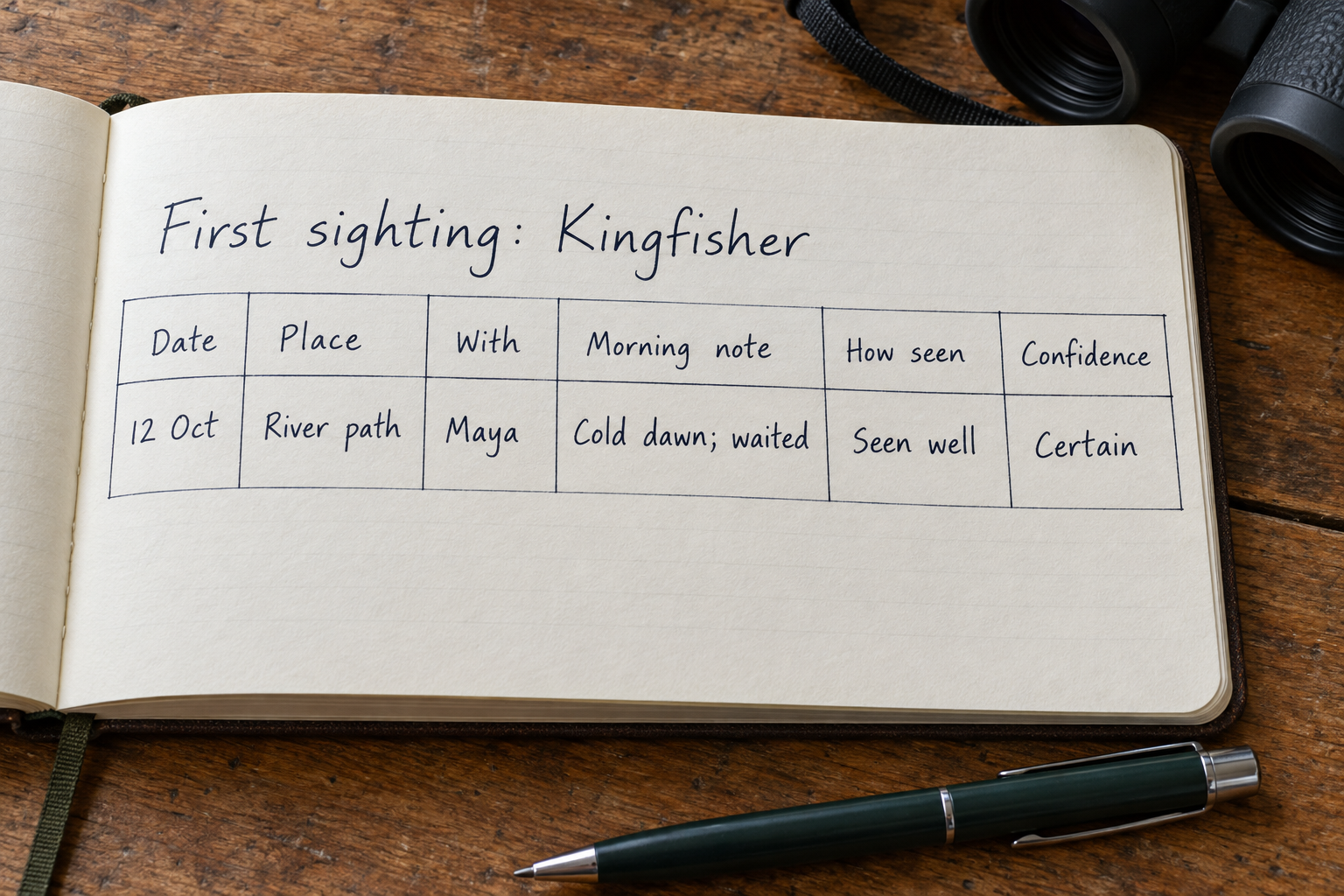
The circumstance line is the whole trick
One sentence, in your own words, about what was happening. Not a description of the bird — a description of the morning.
“Soaked through, about to turn back, and then there it was in the hedge.” “Fourth attempt at this spot. Finally.” “My brother saw it first and has mentioned it approximately once a month since.” “Six in the morning, nobody else on the path, and I had to sit down afterwards.” Ten or fifteen words from the version of you who was standing there beats any amount of careful description added later from memory.
Two rules make it work. Write it the same day, ideally within the hour, in whatever form you’ll actually transfer later. And write the part you’d tell a friend, not the part you’d put in a report — a row that says “nothing special, just finally got one” is honest and still tells you something.
The line also solves a problem that pure lists can’t. Some of the best mornings produce nothing new at all. A list with a free-text field lets you record those as rows too, flagged as not-a-first, and that single habit does more to keep the hobby from curdling into score-keeping than any amount of resolve.
Your rules are yours — so write them down
Every birder draws the lines somewhere slightly different. Heard but not seen. Seen from a car. Birds in captivity or on a feeder at someone else’s house. A bird someone else identified and pointed out to you. Something you watched on a screen while standing next to the person holding the scope.
There is no settling this from the outside, and people who have birded for forty years still disagree about it. The record’s job isn’t to be right about where the line goes. Its job is to state which rules you chose, so a row written in 2026 still means the same thing in 2040.
The practical version is a dated note at the top of the list: a few lines saying what you count and what you don’t. If you change your mind later — and people do, usually in the direction of becoming stricter with themselves — add a new dated line rather than editing the old one. Then the “how you counted it” column does the rest of the work, because you can go back and see which entries would survive your current rules and which wouldn’t, without having to rewrite history.
“A life list doesn’t need to be defensible to anyone else. It needs to be legible to you in twenty years — which means the rules you were using belong inside the list, not inside your head.”
Where the record lives
Here’s the real failure mode, and it has nothing to do with fields. Most people’s life list exists in three places at once: a paper notebook that holds the first few years, an app that holds the recent stuff, and a large amount of it that was never written down anywhere and lives only in memory. Three partial lists are not a list. They’re three reasons to avoid the question.
Pick one canonical home and demote the others to feeders. The phone note you scribble in the field is a feeder; so is the notebook in your bag. Both get emptied into the one real list within a week, and then it doesn’t matter where a sighting was first captured.
A paper diary is the most pleasant to write in, survives decades without a migration, and needs no battery. It also can’t be sorted or filtered, exists in one copy, and is the format most likely to be ruined by a leaking water bottle. If it’s your home, photograph the pages occasionally.
A dedicated birding app handles species names for you, is backed up, and usually connects to something larger. The trade is that you get the fields the designer chose. If there’s no column for “who I was with” or “how I counted it,” you’re writing it into a general notes box where it can’t be sorted on.
A spreadsheet or a general-purpose database app goes the other direction: you define every column, so you can sort by place, filter to heard-only, or pull up every row that mentions a particular person. Everything is typed by hand, which is either a dealbreaker or the point, depending on whether the typing feels like friction or like the small deliberate act that makes you write the sentence.
If you’d rather own the columns
These six fields are a few minutes of setup in Pocket Tables, an iPhone app that’s really a flexible personal database — start from one of the collection templates and add or delete fields until the table matches the rules you actually keep. Being straight about what it isn’t: every entry is typed by hand. It won’t look species up, autocomplete names, check anything against a checklist, map your sightings, sync between devices or share a list with anyone, and there’s no Android version. If you want species lookup and a community attached, a dedicated birding app is the better tool. This is for people who want the circumstance line to be a real sortable field rather than a notes box.
The “don’t start one” objection, taken seriously
There’s a genuine argument in the hobby that life lists are bad for you: that the moment you start counting, you stop looking at birds and start looking at a number, and you end up driving four hours to tick something rather than spending the morning watching what’s in front of you. It isn’t a strawman. People describe exactly that happening to them.
But notice what the argument is actually about. It’s about a list whose only field is a count. Every pathology in that description — the ticking, the chasing, the flat feeling after a morning with nothing new — comes from a record that can only measure one thing and therefore makes that one thing the point.
Change the fields and the incentive changes with them. A list where the richest column is a sentence about the morning rewards good mornings, including the ones that produced nothing new. A list that doesn’t display a running total doesn’t put a number in front of you every time you open it. A list with a confidence column makes “I’m not sure” a normal thing to record instead of a reason to either inflate the count or leave the row out. The fix for score-keeping is not abstinence from records. It’s which fields you keep.
A blunt test: open your list and ask whether it’s more interesting to read than to count. If counting is all it supports, the objection applies to your list specifically — and that’s a fields problem.
Common questions
What about birds I saw years ago and never wrote down?
Backfill them, honestly. Put in the approximate date you can defend — “spring 2014” or just the year — and use the confidence column to mark it as reconstructed. A row that admits it’s fuzzy is more useful than one pretending to a precision you don’t have.
Should the life list be separate from my day-to-day notes?
Either works, and the deciding factor is how much you log. If you write something down most outings, keep one table of sightings with a flag for firsts, and your life list becomes a filtered view rather than a second thing to maintain. If you only log the firsts, a single small table is simpler and you’ll never fall behind on it.
How do I record a sighting I’m not sure about?
Record it with the doubt attached rather than leaving it out or quietly rounding up. A row marked unsure, with a note on what you’d want to see next time, keeps the information without contaminating the rest of the list. You can always upgrade it later; what you can’t do is recover a sighting you never wrote down because you couldn’t decide.
How precise should the location be?
For your own copy, as precise as you find useful. For anything you share, birders differ on this and many keep certain sightings deliberately coarse — a general area rather than an exact spot. The workable approach is two fields: a private one at whatever precision you like, and a shareable one you’ve already decided is fine to pass on.
Is a photo column worth adding?
It’s a nice addition and a poor substitute. A photo tells you what the light was like and very little about what the morning felt like. Add the column if you like, but add it after the sentence, never instead of it.