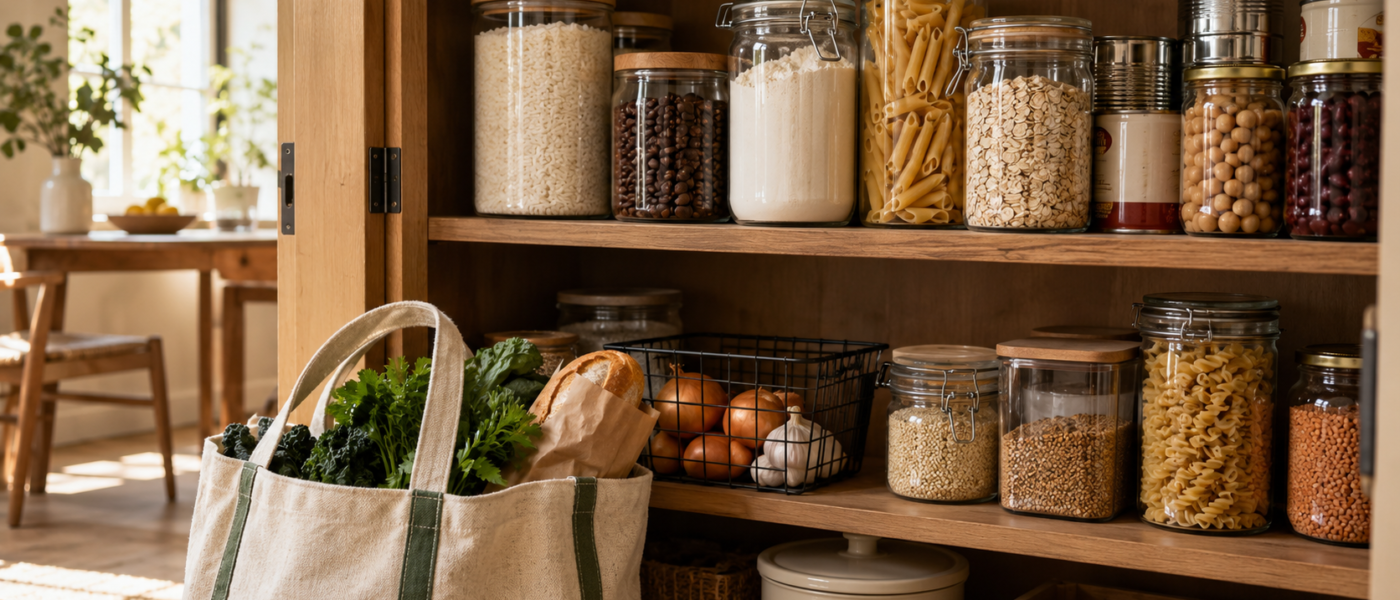
Almost everyone builds the same pantry inventory. A weekend, a clear shelf, every can and jar and bag typed into a list two hundred rows long. It is genuinely satisfying for about nine days. Then you use four things on a Tuesday without updating anything, the counts go wrong, you notice they are wrong, and you stop trusting the list. A list you do not trust is a list you do not open.
The failure is not laziness. It is arithmetic. A complete inventory only stays complete if you log consumption — every tin opened, every cup of rice taken out, every snack a teenager removed at eleven at night. Nobody does that, and nobody should have to. So the honest version of this task is not “record the pantry.” It is “record the small number of things where being wrong costs you something.”
Why a complete pantry inventory dies in nine days
Start with the honest test: if your pantry is one cupboard and you can see the whole of it when you open the door, you do not need a list. Your eyes are faster, always up to date, and free. Writing down what is visible is a hobby, not a system. Close the tab.
The list becomes worth the trouble when the contents are not visible in one glance — a chest freezer, a garage shelf, a deep cupboard where the back row is behind the front row, a second kitchen in the basement. That is a different problem, and it has a much smaller answer than two hundred rows.
There is a second reason the complete version collapses. Most of what sits in a pantry is one-off: the jar you bought for one recipe, the thing someone brought over, the bag of something you tried once. Those items never produce a decision. You will not stand in a store wondering whether you already own them. They take up rows, they go stale faster than anything else, and they drag the whole list down with them.
Strip those out and what remains, for most households, is ten to twenty items: flour, coffee, the pasta shape your family actually eats, the dog’s food, dish soap, the cereal that disappears without warning. A list of fifteen rows can be kept accurate by hand. A list of two hundred cannot.
The two questions the list has to answer
Before choosing fields, notice what you are actually asking, because there are only two questions and they happen at different moments.
“Do I already have this?” You are in a store, holding something, half-sure there is one at home. Guess wrong one way and you own three. Guess wrong the other way and you cook on Thursday without it. This question needs a count and a location, and it needs them on the phone in your hand.
“What am I about to run out of?” This one happens at the kitchen counter, usually while writing a shopping list, and it is the question people answer worst. You do not notice the coffee is low until it is gone. This question does not need a count of everything — it needs a threshold on a few things, so that “two left” means something rather than being a number you have to interpret.
Every field worth having answers one of those two. Anything that answers neither is decoration. Nutritional detail, package size in grams, which store it came from, how much it cost — none of that changes what you do in the doorway of a supermarket.
“A pantry inventory is not a catalogue of your food. It is a short, approximate answer to two questions you keep getting wrong in the same two places.”
The ten to twenty items that earn a row
There is a simple filter for what goes on the list. An item earns a row if you have either bought a duplicate of it you did not need, or run out of it at a moment that annoyed you. Both of those are memories, not theory, and most people can list ten of them in two minutes.
| The thing that keeps happening | The row that fixes it |
|---|---|
| You buy a third jar of the same thing because the front of the shelf was full of something else | A count, for the handful of items you buy on autopilot |
| You discover there is no coffee at 6:40 on a Monday | A reorder point — the number at which the item goes on the shopping list, not zero |
| Nobody can say what is in the chest freezer without unpacking it | A location field, written at the moment the thing goes in |
| You find a package at the back of the garage shelf and have no idea how long it has been there | The date printed on the package, copied exactly as printed |
| The shopping list says “rice” and there are already four pounds of it | A last-checked date, so you know whether the count is still believable |
| The jar you bought for one recipe in March | No row at all. It is not a repeat item and it will never answer either question |
So the row itself is short: a name you would recognize on a shelf, a count, a location, a reorder point, and a last-checked date. Five fields, and two of them you fill in once and barely touch again.
On the count, be deliberately coarse. “3” is fine for jars and cans. For anything you measure out — flour, oats, rice — a number is a lie within a week, so use a word instead: full, half, low. Three states you can assess in one glance beat a quantity you would have to weigh.
One field needs stating plainly, once. If you record the date printed on a package, record it exactly as printed, and let that be the whole of it. The table stores what the package says; what to do about the food itself is not a decision the table makes, and it is not one this article will make for you. The record exists so that you are not standing in a cold garage squinting at small text, and nothing more than that.
Deep storage is where the record actually pays
The chest freezer is the strongest case for writing anything down at all, because it is the one place where looking is genuinely expensive. Everything is in opaque bags, the labels are face-down, and checking means kneeling on a cold floor moving frozen bricks around for five minutes. The record replaces that, and unlike the kitchen cupboard, the record is not competing with your eyes.
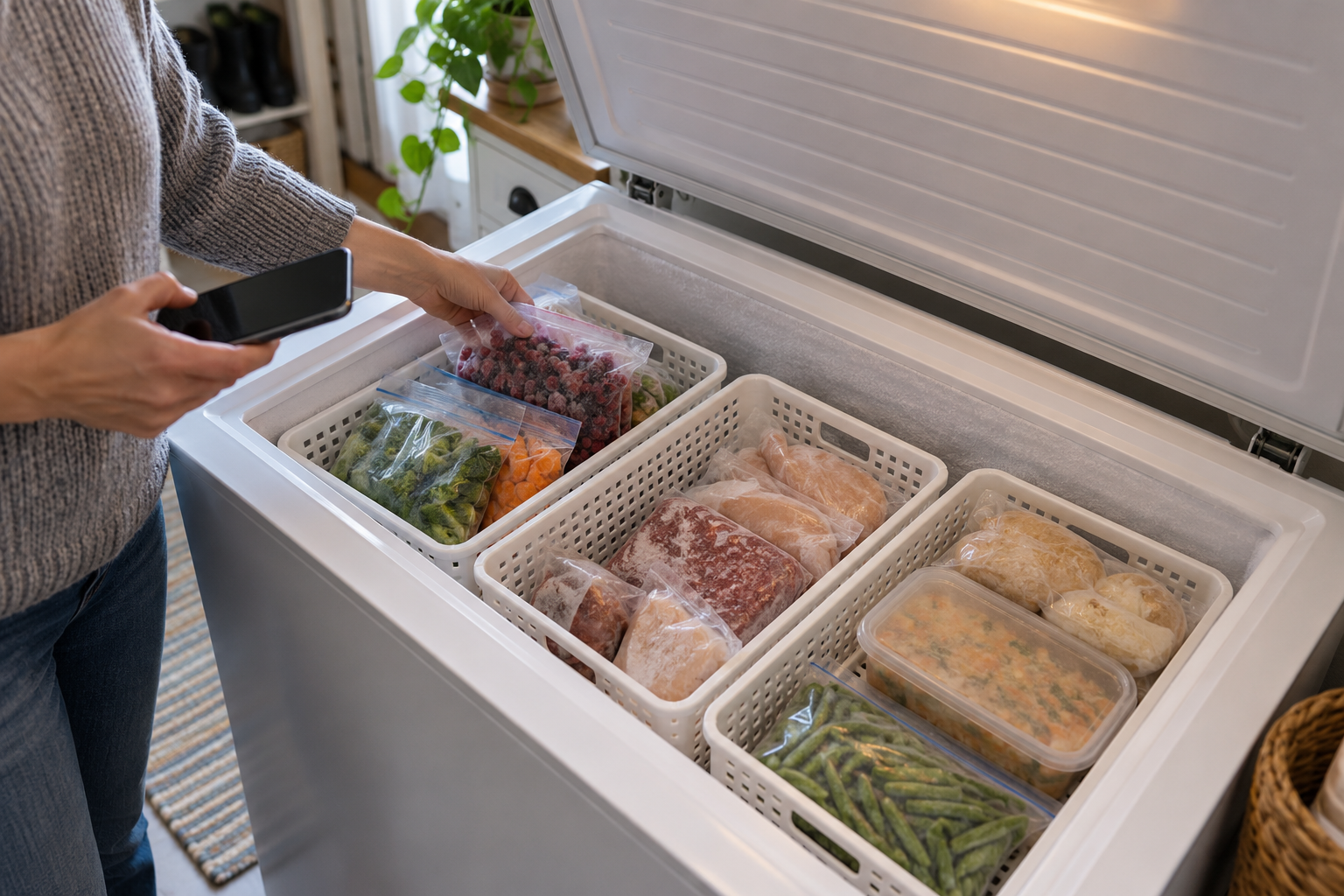
Deep storage also behaves better as data. Things go in rarely and come out rarely, and both moments are deliberate — you are already standing there with the lid open, holding the item. Logging is nearly free at that moment, which is why this list stays accurate when a kitchen list does not.
The useful fields shift slightly here: what it is, when it went in, and which bin or shelf or drawer it is in. For a chest freezer, a number on each basket and a matching number in the list beats any other refinement, because “in the freezer somewhere” is the problem you are solving.
The same logic covers the garage shelf, the basement rack, the cupboard above the fridge that needs a stool. Any place where checking costs more than thirty seconds is a place a row pays for itself.
Where the record lives
The format matters less than the field list, but a few things rule options in and out.
Paper taped inside the cupboard door is better than its reputation, particularly for a freezer: it is right where the decision happens and anyone in the house can cross a line out. It fails the store-doorway question completely, because it is at home and you are not.
A notes app solves that and nothing else. It is on your phone, it is quick, and the moment you want to see only the items below their reorder point it has nothing to offer.
A spreadsheet sorts and filters properly, and is miserable to edit one-handed while holding a freezer lid open. Plenty of people split the difference: edit on a laptop, read on a phone.
Dedicated pantry apps often scan barcodes, which is the fastest way to get items in. The trade is that you get the fields the designer picked, and a reorder point or a bin number may not be among them.
A general-purpose database app sits between the spreadsheet and the pantry app: you choose the columns, entry is phone-shaped, and everything is typed by hand.
If you want to choose the columns yourself
A short pantry list is a small table, and you can build one from the home inventory template in Pocket Tables, an iPhone app that is really a flexible personal database — start from the template, then add a reorder point, a bin number, or whatever your storage actually needs, and delete the rest. The honest trade: every item is typed in by hand. Pocket Tables does no barcode scanning, no product lookup, no reminders, no sync and no sharing with the rest of the household, and there is no Android version. If scanning a barcode is the feature that would make you keep this up, a dedicated pantry app is the better tool. This one is for people who would rather own the fields.
Keeping it accurate without logging every meal
You are not going to log consumption, so the list has to be repaired instead of maintained. Two habits do nearly all of it.
First, update at the moment of purchase and the moment of storage, never in between. Groceries come in, counts go up. Something goes into the freezer, it gets a row and a bin number. Both are moments when you are already handling the item and standing still, which is the only kind of logging that lasts.
Second, reconcile on a fixed schedule rather than continuously. Once a week, before you shop, look at the ten to twenty rows and fix whatever is obviously wrong. It takes two minutes because there are fifteen rows, and that is the entire argument for keeping the list short. For deep storage, once a quarter is enough — open the freezer, check the baskets against the list, correct it.
Expect drift and stop treating it as failure. A count that says 2 when the truth is 1 still tells you that you are nearly out, which is the decision you needed. The list does not have to be right. It has to be right enough to stop you buying a fourth jar.
Common questions
How many items should a pantry inventory have?
Fewer than you think. The working test is whether you can scan the whole list and fix the wrong numbers in about two minutes, because that is the maintenance you will actually do. For most households that lands between ten and twenty rows.
My pantry is one cupboard I can see into. Do I need this at all?
No. If one look answers “do I have this,” a written record is strictly slower and will be out of date by the weekend. The record earns its place only where looking is expensive — a chest freezer, a garage shelf, a deep cupboard with a back row you cannot see. Start there, and only there.
What should I record about the dates printed on packages?
Copy what is printed, exactly as it is printed, and nothing else. The field exists so you do not have to go and read small text in a cold garage. What you then do about the item itself is a judgment the table has no part in, and this article is not the place to look for it.
Do I have to log something every time I use it?
That is the habit that kills these lists, so design around it. Use coarse states — full, half, low — for anything you measure out, update at purchase and at storage, and fix the rest in one short weekly pass. The counts will be approximate. Approximate is enough to answer both of the questions you built the list for.
How do I handle a chest freezer or a garage shelf?
Number the baskets, bins or shelves physically, and put that number in every row. Write the row at the moment the item goes in, while you are already standing there with it in your hand. That one habit does more for a deep-storage list than any amount of tidying, because the problem was never organization — it was that you could not see what was in there.