You know the task is important. That is the annoying part.
It sits there all day with a strangely heavy feeling around it. You open your list, see the thing, close the list, check something easier, and tell yourself you will come back when your brain feels ready. Then the day ends and the task has somehow become more emotionally expensive than it was in the morning.
That loop is not a character flaw. Most procrastination is not a failure to care. It is often a failure to make the next action small, specific, and emotionally safe enough to begin.
The starter task method is built for exactly that moment: when the task is too vague to start, too big to finish quickly, and too easy to avoid.

What Is a Starter Task?
A starter task is the smallest honest version of a task that creates contact with the work.
It is not the full project. It is not the ideal version. It is not the productivity fantasy where you suddenly become a new person at 7:00 AM with perfect discipline and a color-coded planner.
It is the first move that is so clear and low-friction that your brain has fewer reasons to run away.
- Instead of: Write the report
- Starter task: Open the report and write three ugly bullet points
- Instead of: Clean the room
- Starter task: Put five items back where they belong
- Instead of: Study chemistry
- Starter task: Read one solved example and mark what is confusing
The point is not to trick yourself into doing the whole thing. The point is to stop treating starting as if it requires the emotional energy of finishing.
Why Big Tasks Feel So Heavy
A task like “finish assignment” is not one task. It is a messy bundle of decisions: find notes, understand the question, decide structure, write badly, revise, format, submit. When all of those steps are compressed into one line, your brain does the only reasonable thing: it hesitates.
Researchers have been studying procrastination for decades. Piers Steel’s well-known meta-analysis on procrastination connects delay with factors like task aversiveness, impulsiveness, expectancy, and timing. In normal language: we avoid tasks that feel unpleasant, unclear, unrewarding, or too far from a satisfying result.
That is why “just do it” is such bad advice. It ignores the emotional design of the task.
“The task you avoid is often not too hard. It is too undefined.”
This is the “this is so true” part: many people do not avoid work once they are inside it. They avoid the doorway.
You may spend twenty minutes avoiding a task that takes five minutes once opened. The resistance was not the work itself. It was the mental negotiation before the work.
The Starter Task Method
The method is simple enough to use when you are already tired, which is the only kind of productivity system that matters.
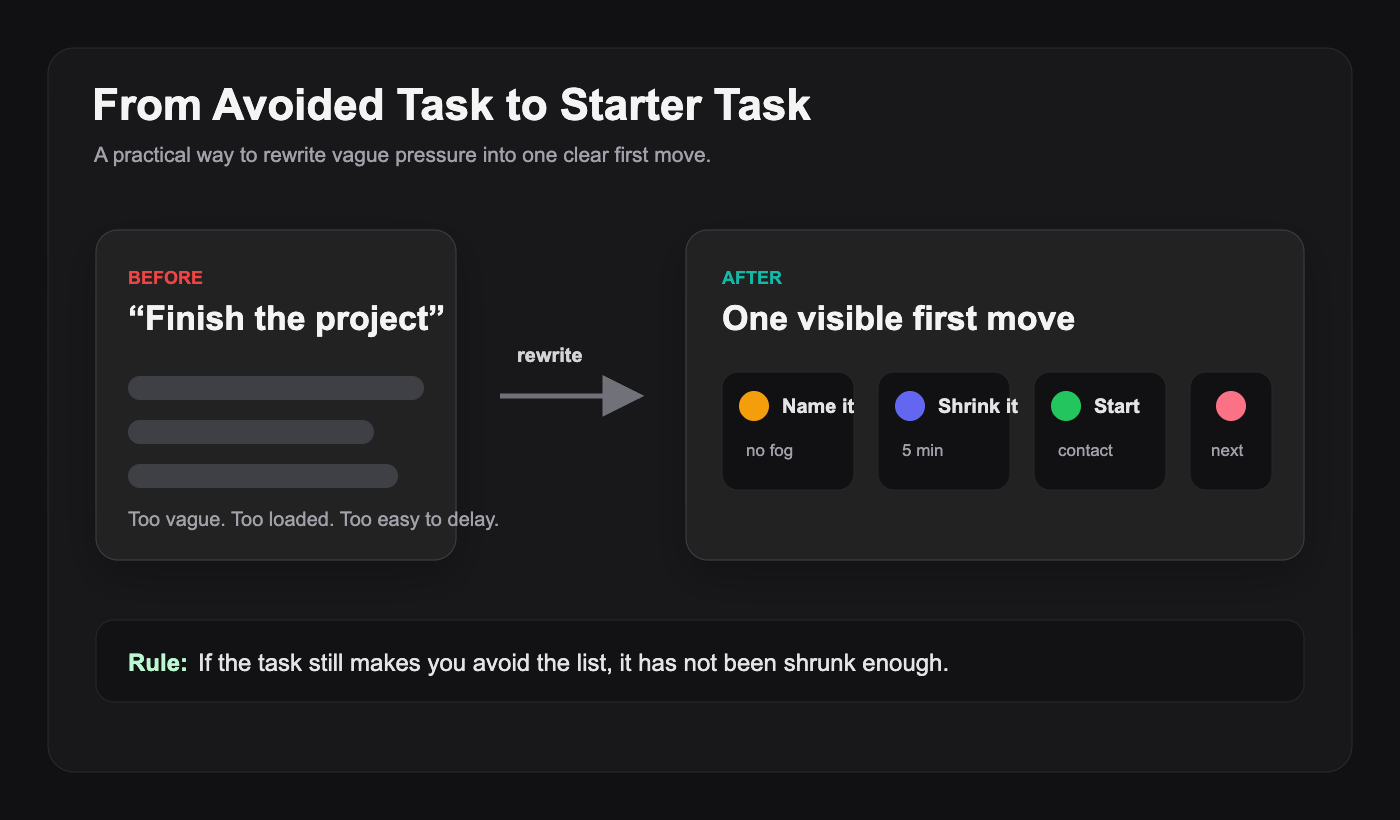
- Name the real task. Write what you are avoiding without dressing it up.
- Find the smallest visible action. Choose something you can do in under five minutes.
- Remove one piece of friction. Open the document, place the notebook, clear the first tab, or set the file beside your keyboard.
- Start without promising to continue. Give yourself permission to stop after the starter task.
That last step matters. If your brain suspects that “start for five minutes” secretly means “work for three hours,” it will stop trusting the system. The starter task must be a real agreement.
Why This Works Better Than Motivation
Motivation is unstable. It depends on sleep, mood, stress, novelty, fear, and how many other tiny demands have already drained you that day.
Starter tasks work because they reduce the need for motivation. They rely on clarity instead.
There is also a useful connection to implementation intentions, the “if-then” planning technique studied by Peter Gollwitzer and Paschal Sheeran in a widely cited meta-analysis on goal achievement. A goal becomes easier to act on when the situation and behavior are made specific: if it is 6 PM, then I open the notebook and write one line.
A starter task adds the missing emotional layer: make the action small enough that you do not need to win an internal argument first.
| Common task | Why it triggers avoidance | Starter task version |
|---|---|---|
| Prepare for exam | Too broad | Solve one previous question |
| Update resume | Feels personal and high-stakes | Fix one bullet point |
| Start workout | Requires energy upfront | Put shoes on and do two minutes |
A simpler way to keep starter tasks visible
If your task list keeps turning into a graveyard of ambitious intentions, a lighter system can help. Apps like Task Bucket make sense for this style of planning because the emphasis is on reducing procrastination pressure, not building a complicated productivity command center.
How to Write a Starter Task That Actually Works
A good starter task has three qualities: visible, physical, and finishable.
Visible
You should know exactly what success looks like. “Work on portfolio” is not visible. “Create one project title and paste one screenshot” is visible.
Physical
Even digital work needs a physical-feeling action. Open, rename, move, write, highlight, delete, sort. Verbs that your body understands reduce mental fog.
Finishable
The starter task should end cleanly. If it cannot be completed in a few minutes, it is still too large.

Use Buckets, Not Endless Lists
One reason people abandon task management apps is that everything ends up in the same place: bills, ideas, urgent work, personal errands, emotional obligations, half-plans, and someday dreams. The list becomes a room with every drawer open.
A bucket-based approach is calmer. You can separate tasks by energy, context, or emotional weight:
- Two-minute starters: tiny actions for stuck moments
- Deep work: tasks that need focus and a clean block
- Admin: small life-maintenance actions
- Waiting: tasks blocked by someone else
- Later: real tasks that do not need today’s attention
This is where Task Bucket for Android fits naturally. Used well, it can become a place to separate “real work” from “starter moves,” which is often the difference between a list you avoid and a list you actually use.
A Small Weekly Reset
Once a week, scan your task list and ask one question: “Which task has become emotionally stale?”
That is the task you keep moving forward without touching. Convert it into a starter task immediately. Do not wait for Monday motivation. Do not redesign your entire system. Just make the next move less dramatic.
- Pick one avoided task.
- Rewrite it as a five-minute starter.
- Put it in a visible place.
- Do it before opening entertainment, messages, or news.
The aim is not to become a productivity machine. The aim is to stop letting unclear tasks quietly tax your attention all day.
FAQ
What is the starter task method?
The starter task method is a way to beat procrastination by converting a large or vague task into the smallest clear action that creates contact with the work.
How small should a starter task be?
Small enough to complete in about two to five minutes. If the action still feels heavy or unclear, shrink it again.
Is this the same as breaking tasks into steps?
It is related, but more focused. A starter task is not a full project plan. It is the first low-friction action that gets you past avoidance.
Can a task app help with procrastination?
Yes, if it helps you clarify and organize next actions instead of becoming another place to store pressure. A simple anti-procrastination app such as Task Bucket can support the method when you use it to capture small starter moves.