
The obvious version of this is a note on your phone called “gift ideas.” Mine, one November, read: candle, hiking socks, the bee book, pasta thing, wind chimes?, something for the kitchen. Six entries, six strangers. I had no idea who any of them were meant for, whether the person had said it in March or the week before, or whether they had already gone out and bought the thing themselves.
The note wasn’t empty. That’s the part people get wrong about gift lists — the assumption that the failure is forgetting to write things down. The real failure is writing down the noun and nothing else. A noun with no owner, no date and no status isn’t an idea; it’s a riddle you’ve set for yourself, and you have to solve it during the one stretch of the year you have the least patience for riddles.
What the December version of you actually needs
Work backwards from the moment the list gets opened. It isn’t opened when you’re relaxed and curious. It’s opened under a deadline, with a fixed number of people to cover and a shrinking number of days, and you’re running a short series of questions against each line.
Who is this for? Did they say it, or did I invent it on their behalf? How long ago — is it a want they still have, or a phase that passed? Have they already bought it? And if I can’t remember the detail, who do I ask?
A bare noun answers none of those. Worse, it can’t tell you whether it’s a good idea, because what made it a good idea was the context — the tone, the sentence around it, the fact that it came up twice. Strip that out and every line looks equally plausible and equally unconvincing, which is why the list gets ignored.
The five fields that save it
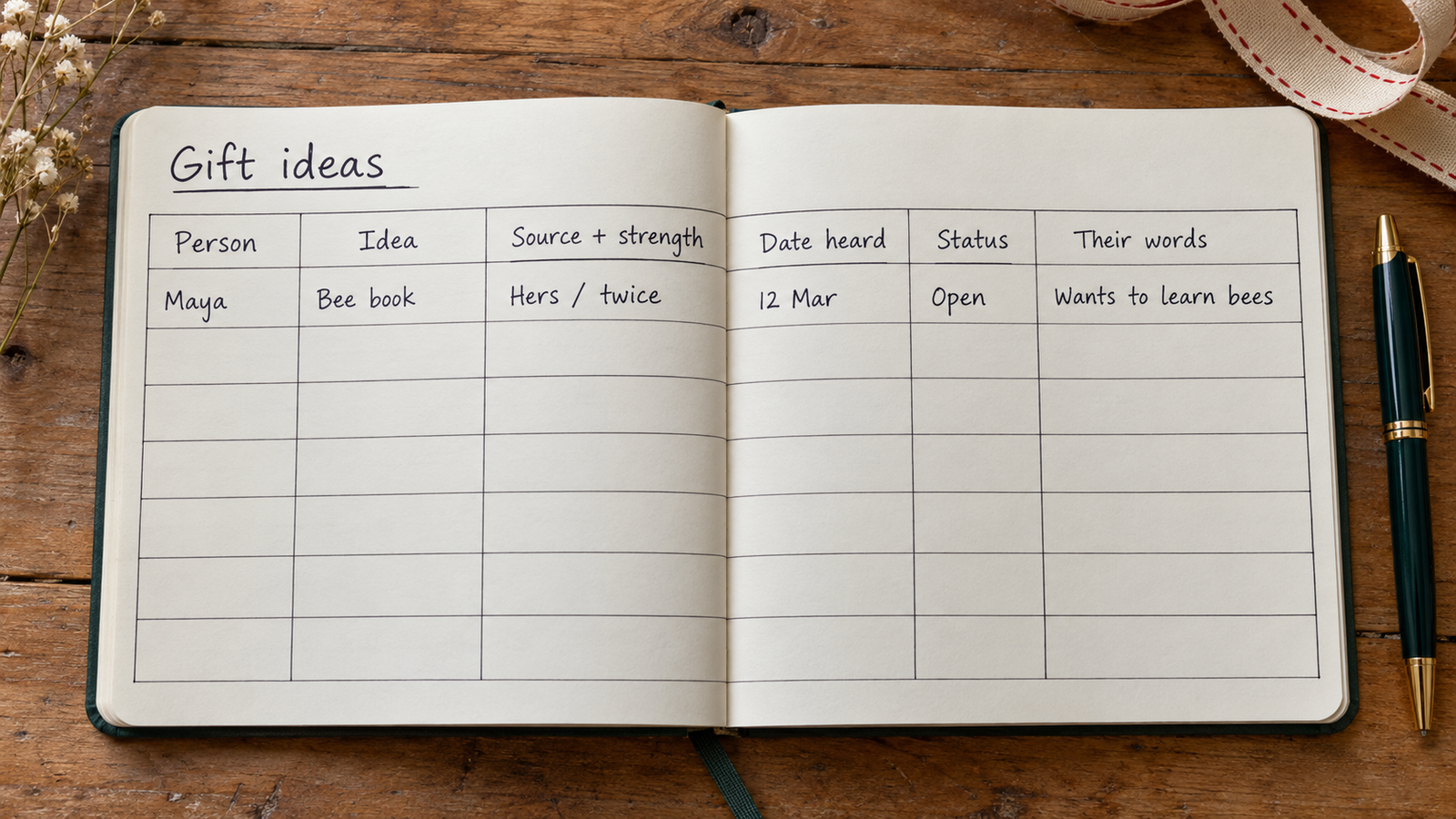
You don’t need a wishlist platform or a tagging system. You need the noun plus four small columns, each of which maps directly onto one of the questions above.
| The question in your head | The field that answers it |
|---|---|
| “Who on earth is the pasta thing for?” | Person — one name, always filled in |
| “Did she want this, or did I decide she wanted it?” | Source — her words, a third party, or your own guess |
| “Is this still current, or has it passed?” | Date heard — the day you wrote the line, not the occasion |
| “Has he bought it for himself since?” | Status — open, checked, bought, given, dead |
| “Was that a real want or small talk?” | Strength — mentioned once, mentioned twice, outright asked for |
| “What exactly did they say?” | The quote, roughly as spoken |
Person. Obvious, and the most frequently skipped field on the planet, because at the moment of writing it is blindingly clear who you mean. It will not be clear in eight months. One name, every time, even when the entry is two words long.
Source. This is the field that separates a list of gifts they want from a list of gifts you’d like them to have. Both belong on the list, but they are not the same thing, and you need to know which is which when you’re deciding between two lines. Mark it in the shortest possible way: their initial if they said it themselves, someone else’s initial if it came second-hand, your own if you thought of it.
Date heard. Not the date of the occasion — the date the sentence happened. This is the field that makes the list self-cleaning. An idea from three weeks ago is almost certainly still live. An idea from two years ago is a coin flip, and you should treat it as a lead to confirm rather than a plan to execute.
Status. The difference between a list and an archive. Open means nobody has done anything about it. Checked means you’ve confirmed recently that they still don’t have it. Given means you already gave it — and a given line is worth keeping forever, because the fastest way to repeat yourself is to delete the evidence.
Strength and the quote. These two are nearly the same field and you can collapse them if you want to. “Said twice, unprompted” is a different proposition from “nodded when someone else brought it up,” and the actual words carry that signal better than any rating. Write what they said, not what you concluded from it. Your conclusion will still be available later; their sentence won’t.
“The good ideas don’t arrive in December. They arrive in a kitchen in April, in the middle of a sentence about something else, and they last about four seconds.”
Capture has to fit in three seconds
Here’s the constraint that decides whether any of this survives contact with real life: the useful ideas surface while the person is still in the room, usually mid-conversation, and you have roughly the length of a sip of coffee to get them down. If your capture takes longer than that, you will either break the conversation or lose the idea, and you’ll pick losing the idea every time.
So the entry has to be enterable in one motion, thumb only, without looking engaged in a task. That rules out anything with required fields, mandatory categories or a save dialog with options. It also rules out doing it later, which is the universal plan and the universal failure — “later” arrives after you’ve driven home, and by then you have the noun and not the sentence.
Two things make the three seconds work. First, make person and date the only things you ever have to think about, and let the date fill itself in from today. Second, put the whole rest of the entry in one free-text line, in whatever shorthand you like: “K — espresso cups, hers are chipped, said it twice.” That’s one line, it’s enterable while nodding, and it reconstructs the entire conversation eight months later. The rest — splitting that line into columns, confirming a status — is a tidy-up job you can do on a train. What can’t be done later is the sentence itself.
The field that decays: status
Every other field is a fact that stays true. The day you heard something does not change. Status does, constantly, and without telling you — because the person is out there living their life and buying their own things.
So treat status the way you’d treat a note about train times: useful, but stamped with a date or worthless. “Checked in September” tells you something. “Checked” on its own tells you nothing, because you don’t know whether that was last month or two birthdays ago. Pair the status with the date you last confirmed it and the field stops lying to you.
The practical rule: for anything heard more than a few months ago, the status is unknown regardless of what the column says, and the first move is a confirmation rather than a purchase. Confirming rarely requires asking directly: whoever was in the room usually knows, and a sideways question to a sibling or a housemate costs nothing. If you do have to ask the recipient, asking in July is a casual conversation; asking in late December is a tell.
One more decay case deserves a column if your family does this: whether someone else has claimed the idea. Two people arriving with the same thing is avoidable only if the list can record that your sister called it first.
Where the list lives
The platform matters less than the fields, but it decides whether the three-second capture is possible, so it isn’t nothing.
A notes app wins on capture and loses on everything else. Nothing is faster to open and type into, which is exactly why most gift lists start there. It just can’t filter, so the moment the list crosses a couple of dozen lines and five people, you’re scrolling and squinting instead of looking something up.
A spreadsheet is the opposite trade. Real columns, real sorting, filter to one person in a second — and genuinely awkward to type into one-handed while standing in someone’s kitchen. The common compromise is to capture in a note and move lines into the sheet in a weekly or monthly sweep.
Wishlist and registry services solve a different problem well: the recipient maintains their own list and you avoid duplicates. They’re excellent for the people who’ll actually keep one, and useless for everyone else, which is most people. They also can’t hold the thing you overheard, which is where the best ideas come from.
A database-style app sits in between: defined fields, phone-shaped entry, filtering by person or status. You type everything by hand and nothing is looked up for you.
If you want the columns rather than a wishlist
These fields come set up in the gift ideas template for Pocket Tables, an iPhone app that’s really a flexible personal database — start from the template, then add or delete fields until the table matches how you collect ideas. Straight about the limits: every line is typed in by hand, and it won’t look products up, fetch prices or images, suggest anything, sync between devices, or let a family share one list, and there’s no Android version. If you want relatives to maintain their own lists, a wishlist service is the right tool. This is for the ideas you overhear.
Working the list when an occasion arrives
Maintenance on a gift list is lighter than on most lists, because the occasions do the prompting for you. It comes down to one habit and one pass.
The habit: never close the list without setting the status. If you looked at a line and decided against it, mark it dead with half a reason — “already has one,” “she was joking” — so it doesn’t come back next year wearing the same innocent face. Lines that sit at open forever are the ones that make the list feel untrustworthy.
The pass: a few weeks before each occasion, filter to that person, sort by date heard with the newest at the top, and read down. Recent and strongly worded entries are your shortlist. Old entries with a vague quote are leads to confirm. Anything already marked given is your history, and it’s doing real work — it tells you what landed, what you’ve already covered, and which categories you’ve quietly gone to three years running.
Then do the thing almost nobody does: after the occasion, spend one minute writing down what you actually gave and how it went over. That single line is the most valuable entry on the whole list next year, and it only exists if you write it while you still remember the face.
Common questions
When should I be adding to a gift list?
All year, because that’s when the ideas happen. Almost nothing good gets added in the four weeks before an occasion — by then you’re guessing rather than remembering. The entries that save you are the ones captured in an ordinary conversation in March, which is also why capture speed matters more than any other part of the system.
One list for everyone, or one per person?
One list with a person field. Separate lists per person feel tidier and break immediately, because capture has to be instant and choosing which list to open is a decision you don’t have time for. With a person column you get the same per-person view by filtering, and you keep a single place to type into.
What about ideas I came up with myself?
Keep them, and mark the source as you. They’re legitimate — some of the best gifts are things the person never would have asked for. But they belong in a different mental bucket from something that came out of the recipient’s own mouth, and when you’re choosing between two lines under time pressure, knowing which is which is the whole point of the field.
How do I avoid buying something they already bought themselves?
The date heard field does most of the work: anything older than a few months is a lead, not a plan. Before acting on an old entry, confirm it — usually through whoever was in the room when it came up, rather than by asking the recipient. Then write the confirmation date into the status so your future self knows how fresh the information is.
Should I record what I gave in previous years?
Yes, and it’s the cheapest high-value habit in the whole thing. A given line with a year and a one-sentence verdict prevents the accidental repeat, shows you which kinds of things land with which people, and quietly reveals when you’ve defaulted to the same category for someone three times in a row. One line per occasion, written the same week.