Start with the fields, because that’s where most logs die. A spreadsheet with twelve columns — title, author, pages, start date, finish date, genre, format, rating, mood, source, cover image, three-paragraph review — is a log you will fill in beautifully for four books and then quietly stop opening. Not because you stopped reading. Because finishing a book now costs you fifteen minutes of data entry, and the log has become a small chore attached to something that wasn’t a chore.
A log that’s still alive in March is usually a narrower one. The useful question isn’t “what could I record about a book?” It’s “what will I want to know in six months that I can’t reconstruct from memory?” Those are very different lists, and the second one is short.
Decide what the log is for first
“Tracking my reading” isn’t a purpose, it’s a category. The purposes people actually have are more specific, and they pull toward different logs:
- Memory. You want to answer “which book was it that had the thing about the lighthouse?” without re-reading three novels.
- Honesty. You suspect the gap between the books you say you’ve read and the books you’ve actually finished is wider than you’d like.
- Pattern-finding. You want to know why some months go well and some don’t, and whether the problem is the books or the format or the hour of day.
- A record. You just want a list, years deep, that you can scroll.
A log built for memory needs a line in your own words and nothing else. A log built for pattern-finding needs dates and formats and the reason you picked the book up. A log built as a record needs almost nothing — title, author, month. If you try to build all four at once you get the twelve-column spreadsheet, and that one dies.
The fields that tend to survive
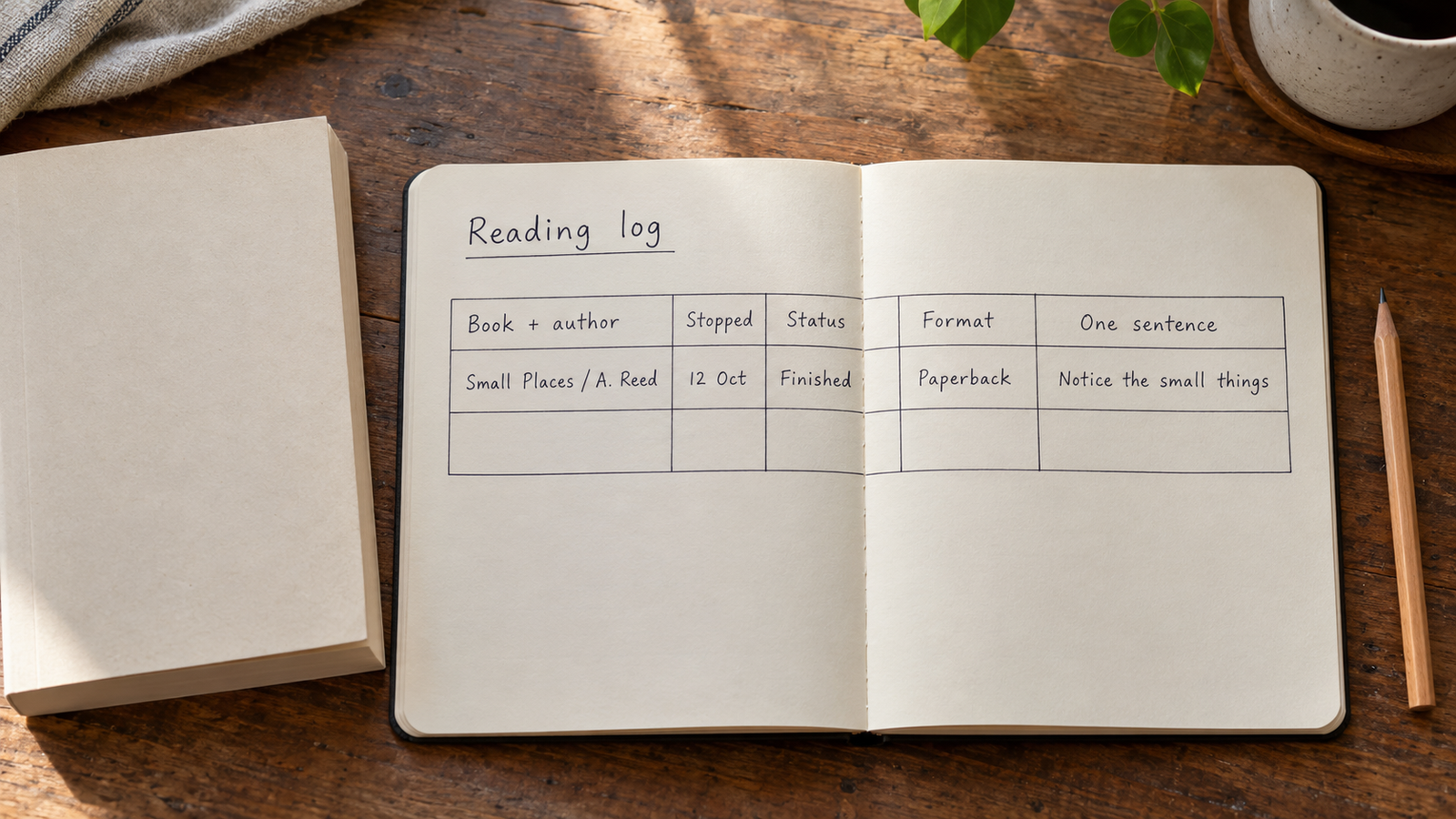
Here’s a small set worth considering, framed by what each one actually buys you later. Take three or four, not all of them.
| Field | The question it answers in six months |
|---|---|
| Title and author | The only field that is genuinely non-negotiable. |
| Date you stopped reading it | Not “finished” — stopped. Tells you how long books really take you, and when a book sat open for five weeks without moving. |
| Status: finished / abandoned / skimmed / reference | Whether your sense of “books I read this year” matches the record. |
| Format | Which format you actually get to the end of, versus which one you like the idea of. |
| Why you picked it up | Which friend, list, or algorithm gives you books you finish — and which gives you books you buy. |
| One sentence, your own words | Whether anything from the book survived in you. This is the field people skip and later wish they hadn’t. |
Notice what isn’t there: page count, genre, star rating. Page count you can look up. Genre is often arguable and rarely useful. Ratings are tempting and mostly harmless, but they drift — a 4 in January and a 4 in August don’t mean the same thing, and you’ll find yourself stalling on an entry because you can’t decide between two numbers. If you want one, use something coarse: would I read another by this author, yes or no.
Log the ones you abandon
This is the field most logs are missing, and it’s the one that changes what the log is good for. A list of finished books is a list of your successes. A list that includes the four books you stopped at page 60 tells you something you can act on.
Abandoning a book isn’t a failure worth recording as a confession — it’s information. If three of your four abandons were 500-page hardcovers you were carrying on the train, the problem is logistics. If they were all nonfiction you bought because you felt you should have read them, the problem is how you choose. If they were all audiobooks you lost the thread of while driving, the problem is the format, not the book.
Practically: give abandons the same row as anything else, with a status and a date and, if you can manage it, one clause about where you stopped and why. “Lost interest around the second trial” is enough. You don’t need to justify it.
“A list of only the books you finished is a list of your wins. A list that includes the ones you put down is a list you can learn from.”
The books you only think you read
There’s a third category beyond finished and abandoned, and it’s the one worth being honest about: books you’ve absorbed secondhand. You’ve read the long excerpt, listened to two interviews with the author, seen the ideas quoted enough times that you can summarize the argument — and at some point you started saying you’d read it.
This isn’t dishonesty so much as drift, and a log is the only thing that catches it. If your statuses include something like skimmed or partial, the drift shows up as soon as you look at the rows. A book marked “read the first 40 pages and three reviews” stays accurately filed, and when someone asks you about it you’ll answer more precisely.
The same goes for reference books — the cookbook, the manual, the thing you dip into. Marking those as “reference” rather than finished keeps your count meaningful. The point isn’t to be strict with yourself. It’s that a log you can’t trust is worse than no log, because you’ll quote it.
Where to keep it
The format matters less than the friction, and the friction is almost entirely about where the log lives relative to where you are when you close a book.
Paper. A notebook or index cards. Fastest to write in, pleasant to flip through, and effectively unsortable — you can’t ask it “which formats did I abandon?” If your purpose is memory or a record, that’s fine.
A spreadsheet. Sorting and filtering for free, which makes pattern-finding real. The cost is that typing into a spreadsheet on a phone is unpleasant enough that entries get postponed, and postponed entries become no entries.
A reading-tracker app. This category usually gives you barcode or ISBN lookup, imports, ratings, social feeds and reading challenges — a book appears in your log in a few taps. The trade is that you work with the fields the app offers, and the log tends to come with an audience and a yearly goal attached, whether you wanted those or not.
A plain personal database. You define the fields; you type the books in. More setup, no lookup, total control of what the log asks you for.
If you want to pick your own fields
That last category is what Pocket Tables is — a flexible personal database for iPhone, where you start from the book tracking template and then add or delete fields per table until the log asks only what you’ll actually answer. No account, and the data stays on the phone. Be clear about the trade, though: every book is typed in by hand. It doesn’t scan ISBNs or barcodes, doesn’t import from Goodreads or anywhere else, doesn’t sync between devices, can’t be shared with a book club, and there’s no Android version.
Look at it once a month
A log nobody reads is just typing. Five minutes at the end of the month, scrolling your own rows, is where it starts paying: three abandons in a row, the one book you finished in four days, the recommendation source that’s gone two for two. You don’t need a system for this review. You need to open the thing.
And when a field keeps going blank, delete it. A column you’ve skipped six times isn’t a discipline problem — it’s a field you don’t want. Cutting it makes the next entry easier, which is the whole trick.
Common questions
What should I write in a reading log entry?
At minimum the title, the author, and the month. If you want the log to be useful later, add a status (finished, abandoned, skimmed) and one sentence in your own words about what the book was actually doing. Everything beyond that is optional and should earn its place.
Should I log books I didn’t finish?
Yes, and they’re often the most informative rows. Give them a status and a date and a short note on where you stopped. The pattern across several abandons usually points at something fixable — the format, the length, or how you were choosing books.
Do audiobooks count?
Count them if you want to, but record the format. The interesting question isn’t whether audio is legitimate, it’s whether you finish audiobooks at a different rate than print, and you can only see that if the format is in the row.
Is a notebook or an app better?
Whichever one is already in your hand when you close a book. Paper is faster to write in and impossible to sort; digital logs can be filtered and queried but ask slightly more of you at entry time. Pick for friction, not for features.
What if I’ve already stopped updating mine?
Don’t backfill. Reconstructing six months from memory is the exact chore that killed it the first time. Delete the fields you kept skipping, start again from the book you’re reading now, and leave the gap visible.