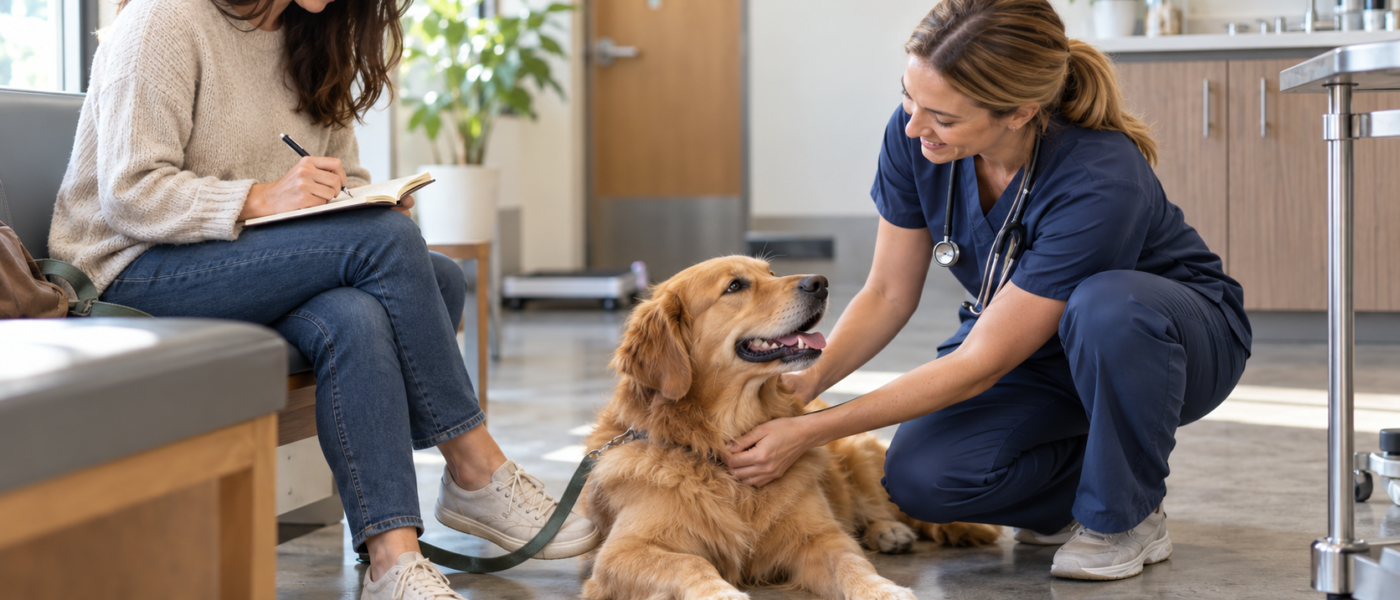
The obvious way to keep a pet health record is to write down everything. Every meal, every walk, every odd noise. People start one in week one of a new dog and abandon it by week five, and almost nothing is lost when they do, because a diary has no reader — not you, and certainly not the person in scrubs who has eight minutes with you.
A pet record gets used in two situations, and both are short. In the first, someone at a clinic asks you six fast questions while the cat is still in the carrier. In the second, you hand the animal over to somebody else — a sitter for the weekend, a new clinic after a move — and everything they need has to be written down already, because you won’t be there to answer. Build the record backwards from those two moments and it comes out smaller than a diary and far more useful.
The record’s job is about five minutes long
Your clinic has a file on your pet and will still ask you questions at the start of the visit, because the things they need are the things only you know: what changed at home, what you’re actually giving, and when it started.
The failure mode is predictable, because memory is bad at exactly those two things. Dates become durations — “a couple of weeks ago, maybe three?” — and names become descriptions: “the small white one, twice a day, I think.” Both answers are honest and both are useless. A record’s function is to turn the first into “started October 4” and the second into the product name printed on the label.
The handover fails differently. Nothing is forgotten; it’s all inside your head, which has left the state. The sitter texts at 8:40pm asking how much food, where the carrier is, and which clinic you use, and you answer badly from a restaurant.
What the intake conversation is really after
Listen to the questions and they collapse into three kinds of information, which is a useful shortcut when you’re deciding what to write down.
Names, copied exactly. The product name and strength as printed on the bottle, not your paraphrase. The food brand and the specific variety. The clinic that did the last procedure, so this clinic can request the paperwork. Anything you’ve been told your pet reacts badly to, in the words you were told.
Dates, not durations. When something started, when it stopped, when the last visit was. A duration decays the moment you write it — “two weeks” was true in March and is nonsense now — while a date stays correct forever and can be subtracted from today whenever anyone wants the duration back.
Numbers with a date attached. Mostly weight. One weight is trivia; three across a year is a trend, and the trend is the part worth having.
What the record never does is decide anything. What your pet should be given, how often, and which visits are due comes from your vet, not from a table on your phone. The table’s job is to put accurate facts in front of the person deciding, fast.
The fields that earn their place
Split the record in two, because the halves change at completely different speeds. There’s a profile you write once and edit rarely, and a dated log you add a line to a few times a year. Keeping them separate is what stops the whole thing turning back into a diary.
The profile holds identity and logistics: name, species, breed or best guess, age or your estimate, color and distinguishing markings, microchip number and registry, insurance policy number, the clinic’s phone, the nearest after-hours clinic, the current food as an exact product with amounts and times, medications and supplements transcribed off the labels, anything you’ve been told to avoid, and two or three behavior notes that matter to a stranger — hates the carrier, bolts at the door, fine with dogs and not with the vacuum.
The log is one row per event: date, what happened, which clinic or person, weight if it was taken, cost, and where the paperwork lives. A few rows a year for a healthy animal, which is the point — short enough to read the whole history in one screen.
| What you record | At the start of an appointment | In a sitter or new-clinic handover |
|---|---|---|
| Medications copied off the label | Asked in the first minute; describing the pill stalls the visit | Right bottle, right routine, no 9pm text to you |
| Weight, with the date beside it | Turns one number into a trend across visits | What a boarding or daycare form asks for |
| Dates things started or stopped | “October 4” survives the retelling; “a few weeks ago” doesn’t | Lets someone else tell new from normal |
| Clinic phone and nearest after-hours clinic | How a new clinic requests your existing records | The most-needed line on the whole page |
| Microchip number and registry | Confirmed at check-in in seconds | What turns a found animal into a phone call |
| Food as an exact product and amount | Context for anything diet-related you’re asked | Removes the guesswork behind most sitter questions |
Nothing on that list requires you to know anything medical. It’s names, dates, numbers and phone numbers — the clerical half of pet ownership, which is the half that reliably goes missing.
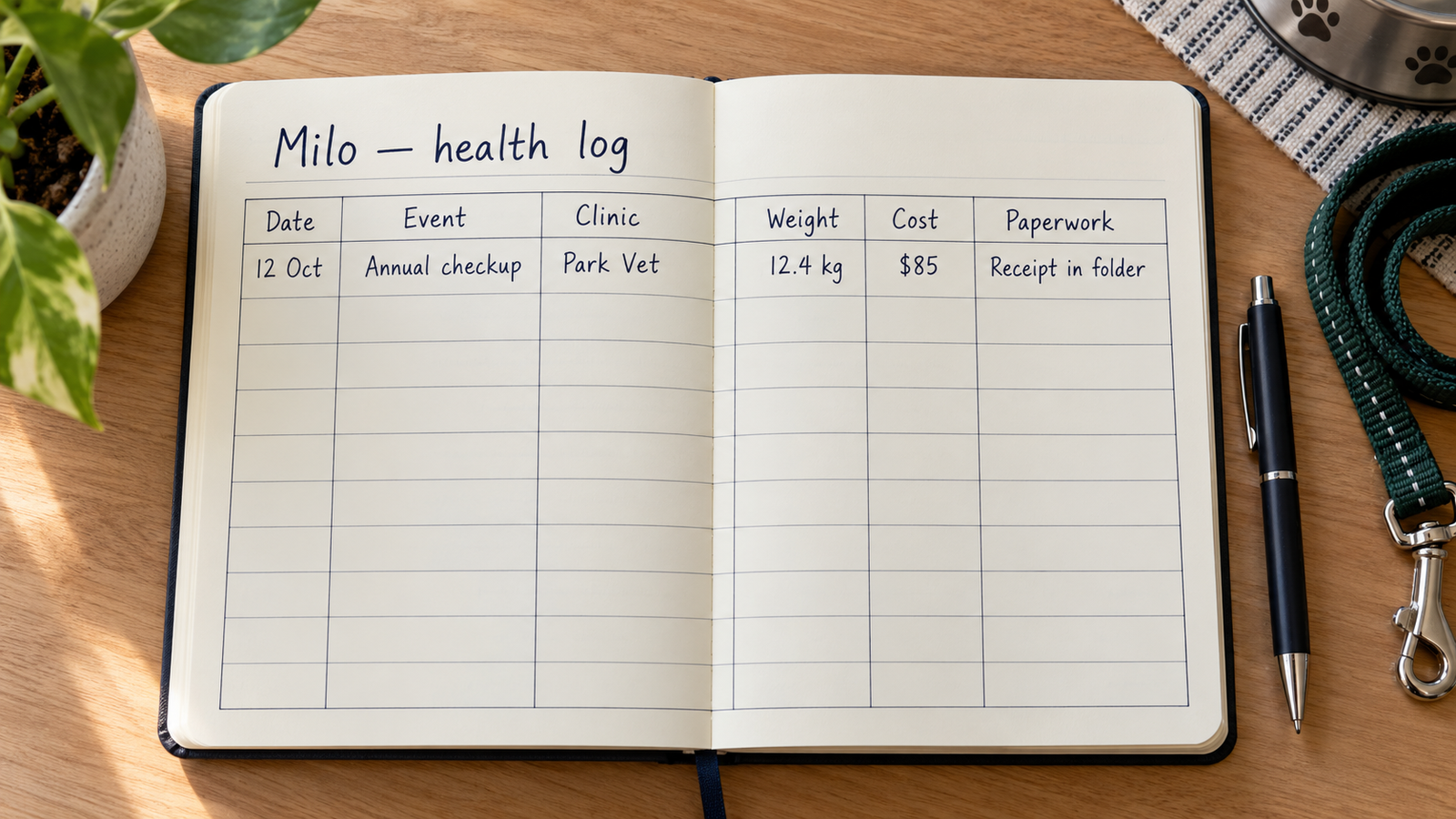
The handover page is a different document
The mistake people make when a sitter arrives is handing over the history. Nobody watching your dog for four days needs the log. They need the next seventy-two hours, on one page.
That page is short. Feeding in exact amounts and times, with where the food is kept. The medication routine written out as a routine — what, from which container, at what times — transcribed from what your vet wrote, with nothing added or adjusted by you. Where the leash, carrier and cleaning supplies are. Your number, plus one backup human who can decide if you can’t be reached. The clinic and after-hours clinic again, because this page has to stand alone. The microchip number, and two photos: one full-body side view and one of the face, which is what a lost-pet post needs and what nobody can take later.
Two items are less obvious and worth more than the rest. The first is authorization: whether this person can approve treatment on your behalf, and up to what amount. Decide the number before you leave rather than during a phone call, and ask your clinic how they prefer it noted.
The second is a baseline. Three or four lines on what ordinary looks like: finishes breakfast in about five minutes, sleeps through the afternoon, barks at the mail. A sitter with no baseline either reports nothing or reports everything. A sitter with one can tell you what changed, which is the only thing you want from them — what it means is a question for your vet.
“A pet record isn’t a biography. It’s a handover note, written for a stranger who has a few minutes and needs the facts in the order they’re going to ask for them.”
What to leave out
Four things bloat pet records, and cutting them is most of what makes one survive its first year.
Your interpretation. “Not eating much, I think it’s his teeth” buries the useful half of the sentence in a guess. “Left half of breakfast Tuesday and Wednesday, ate normally Thursday” is a fact, and someone can work with it. Say the theory out loud at the appointment instead, where it can be answered.
Daily entries. A row for every ordinary day stops being readable around week three, and you can’t skim it for the line that matters. The exception is when you’ve been asked to track something for a period — then it’s a separate short log with a start date, an end date and one thing being recorded.
Pasted reading. Articles and forum threads collected at 1am don’t belong next to your pet’s microchip number. They make the record slow to search and invite you to re-read your own worst night.
Precision nobody uses. Weight to the gram when the clinic’s scale reads to a tenth of a pound. Four scans of the same invoice. The test for any field is whether you can name the moment someone reads it; if you can’t, it’s decoration.
Where to keep it, and how to keep it current
Most people need two things, and the useful move is to stop asking one tool to do both jobs.
The first is a document folder: photos or PDFs of certificates, invoices, results and registration paperwork, named so they sort by date. Unglamorous, and the part that saves you at a boarding desk or a new clinic. Any cloud drive does it; the only discipline is naming files the day you get them.
The second is a short structured record — the profile and the log. Your clinic’s portal is authoritative for their own visits, but it knows only those and doesn’t travel when you move. A notes app is good for the handover page and poor at anything you want to sort, like weights over time. A spreadsheet handles trends well and is awkward to type into at a counter with a leash in one hand. Pet apps bundle reminders and document storage, with whatever fields the designer chose. A general database app gives you the fields and asks you to type everything yourself.
Whatever holds it, one update moment reliably works: the two minutes after a visit, before you drive home. The printout and the invoice are in your hand and you won’t get a better chance. Date, weight, what was done, anything that started or stopped, a photo of the invoice. In the parking lot it costs nothing; from memory on Sunday it doesn’t happen.
And when a medication or a food stops, strike it from the profile the same day. A record still listing something your pet no longer takes isn’t just stale, it’s misleading at the moment accuracy counts.
If you’d rather define the fields yourself
The profile-and-log split is set up ready to go in the pet records template for Pocket Tables, an iPhone app that’s really just a flexible personal database — start from the template, then add or delete fields until it matches your animal; there’s no account and the data stays on the phone. Being straight about what it isn’t: every row is typed by hand, and it won’t store scanned certificates or invoice PDFs, send reminders, sync between devices, share with a sitter, or run on Android, and it’s no substitute for your clinic’s own records. If you want reminders and document storage in one place, a dedicated pet app is the more convenient tool. This is for people who’d rather own the columns.
Common questions
Isn’t my vet already keeping all of this?
They keep their own notes on their own visits, and those are the authoritative version of what happened there. What they don’t have is everything that happened elsewhere — the previous clinic, an emergency visit on a trip, what you’re actually feeding, what you noticed at home. Your record is the part that travels between clinics and the part a sitter can read.
How far back should the record go?
Don’t reconstruct years from memory — you’ll get dates wrong, and wrong dates are worse than none. Start with today’s profile, add whatever you have paperwork for, and let the log fill forward. Photograph old invoices into the document folder and note only the date and the clinic in the log.
Should I write down what I think is wrong?
Write what you observed and when, and leave the conclusion for the appointment. “Limping on the left front after Saturday’s walk, normal by Monday” is the sentence that helps. A theory in a record tends to harden into a fact nobody checked.
One record for all my pets, or one each?
One profile per animal, always — mixed-up profiles are how the wrong food ends up in the wrong bowl. A shared log with a name column is fine and often easier, since multi-pet households tend to have visits on the same day. Keep the handover page per animal too.
What should I keep if I have pet insurance?
The thing that saves time on a claim is the itemized invoice, so the field that matters is where that file lives, plus the date, the clinic and the amount in the log. Ask your provider what they want before you need to file — it’s a shorter conversation when nothing is wrong.