
Open a watchlist you built six months ago — one that holds nothing but symbols and a price column — and read it honestly. You’ll recognize some entries straight away and half-recognize others. And a few you won’t be able to place at all: you know you typed them in deliberately, on some specific evening, for some specific reason, and the reason is gone.
That isn’t a discipline problem. It’s a file-format problem. The list stored the one part of the decision that was never scarce. Price is on every screen you own, updated constantly, for free. The scarce part was the sentence you would have written if someone had asked you, on the day you added it, why you were adding it. That’s the part the list didn’t keep.
One thing to be plain about before the fields: this is an article about record-keeping, not about investing. Nothing in it is financial advice. There is no suggestion here about what to buy, sell or hold, no strategy, and no company, fund or ticker named anywhere — the examples are deliberately generic. The subject is how to write your own thinking down so that it is still legible to you a year later.
A column of symbols is a copy of something you already have
Three things go wrong with a symbol-only list, and they compound.
First, it duplicates data you can’t own. Whatever your list says about price is either live — in which case your broker said it first and said it better — or it’s a stale number you typed once, which is worse than nothing because it looks like a record and isn’t.
Second, it flattens entries that have nothing in common. One you spent two weekends reading about sits in the same row height as one you added because a stranger on a podcast said a name you’d never heard. Six months on, both are just a symbol: the list has erased the difference between conviction and curiosity, which was the most important thing about each.
Third, some entries were added to watch for something specific that has since happened, or specifically failed to happen, and you’ll never know which. Once the sentence is lost, so is the question, and the entry becomes a permanent resident of a list it should have graduated from months ago.
The sentence you write on the day you add it
The highest-value field on a watchlist is a free-text line, which is exactly the field that spreadsheets and broker apps either omit or cap at twenty characters. It should answer one question: why is this here?
Not a description of the business. You can look that up in ten seconds, and the description is not what you’ll have forgotten. What you’ll have forgotten is your own state of mind. The useful note sounds like a person talking:
“Added because a supplier I know mentioned their order book is unusually full. I have read nothing official.” “A friend whose track record I don’t know raved about this — parked it here to look at properly, know nothing yet.” “I use this product every day and want to understand the business behind it; no homework done.”
Read those back in six months and they still work. Each tells you what you believed, where it came from, and how much you actually knew. That last part is the detail people lose first and regret most: an entry you never researched can feel, after enough months of familiarity, exactly like one you did.
The fields that earn their place
Work backwards from the questions you’ll actually have when you reopen the list, rather than forwards from everything a table could theoretically hold. The question comes first; the field exists to answer it.
| The question you’ll have in six months | The field that answers it |
|---|---|
| “Why is this even on the list?” | One sentence on why, in your own words, written the day you added it |
| “When did past me think this?” | Date added — the single cheapest field and the one that makes every other note readable |
| “How much do I actually know here?” | Homework level — heard the name, read around it, read the company’s own filings |
| “Who or what put this in front of me?” | Source — the person, podcast, newsletter, screener or shop floor it came from |
| “What was I waiting to find out?” | The open question, written as an actual question you haven’t answered |
| “Did the thing I said I’d watch for happen?” | The condition, recorded in advance and in plain language |
| “Is this entry still live, or did I decide and forget?” | Status, plus one line on why it closed if it did |
Seven fields, six of which are typed once and never touched again. Note what isn’t on the list: current price, day change, market capitalization, dividend yield, anything that moves on its own. Not because those numbers don’t matter to you, but because something else already maintains them perfectly and your list will maintain them badly.
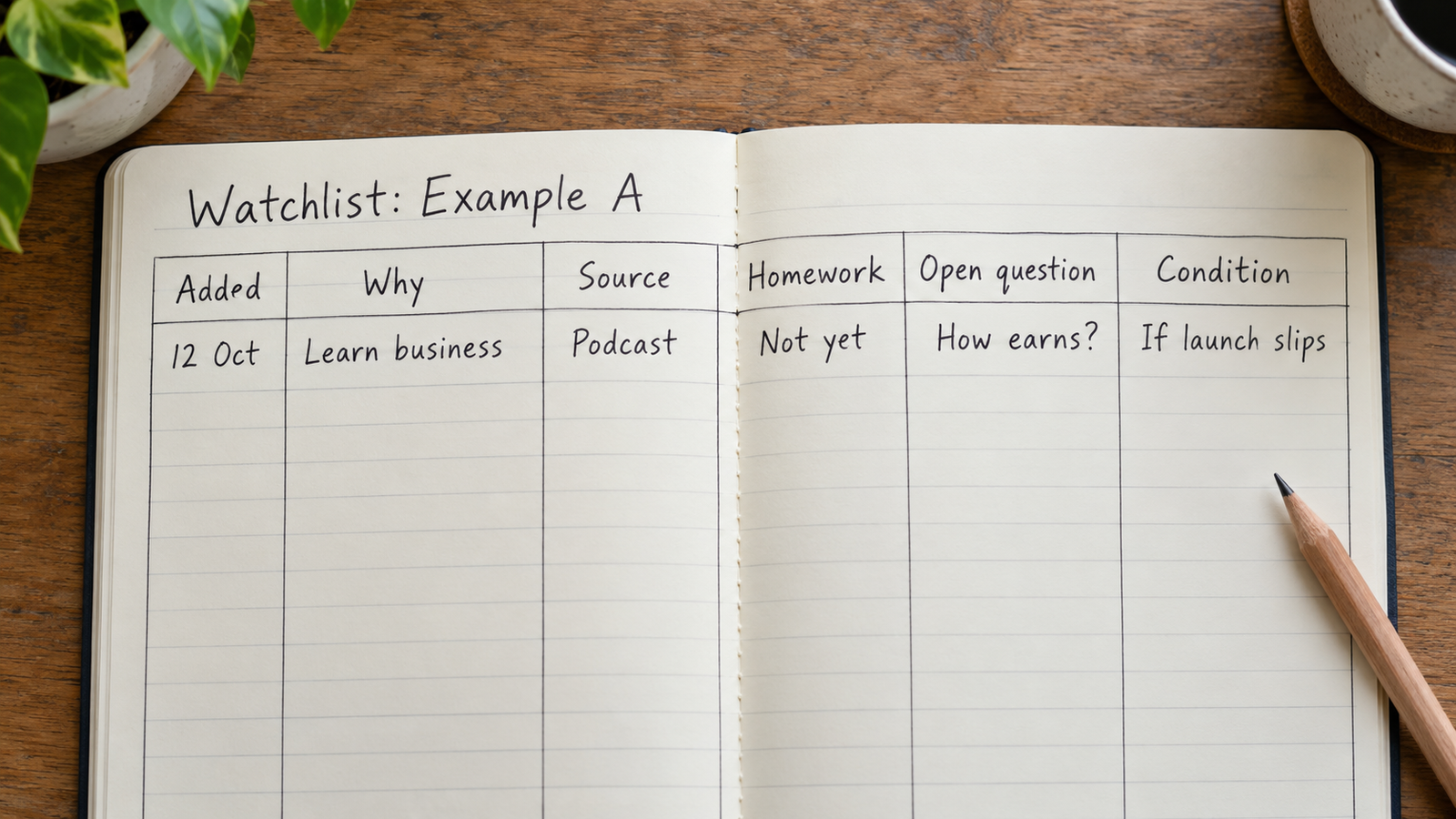
The homework-level field deserves a word on its own. Three options, five seconds, and it prevents the specific failure where familiarity gets mistaken for research: an entry you have reread twenty times feels like one you know well, when all you have done is read the same day-one sentence twenty times.
“What would change my mind” is the field everyone skips
This is the field that converts a watchlist from a holding pen into a record you can grade. The instruction is narrow: on the day you add the entry, write down the observable thing that would make you stop being interested.
Keep it plain and checkable. “If the new product slips past next summer, I stop caring.” “If the founder leaves, my reason for being interested leaves with them.” Each is an event you can go and look up later, which is the only property that matters. A condition you can’t check isn’t a record, it’s a mood.
Be honest when there is no condition. Sometimes the truthful answer is “nothing would change my mind, I just like this company,” and writing that down beats inventing a respectable-sounding test. It labels the entry as taste rather than analysis, and six months later the label is still accurate.
Write it on day one rather than later, for a plain record-keeping reason: day one is the only moment you are not yet attached to the entry. Everything after that is written by someone with a position to defend, even if the position is only having been interested for a while.
“A watchlist isn’t a list of things you might do something about. It’s a dated record of what you thought — written for the only reader who matters, which is you, a year from now, having forgotten all of it.”
Where the list lives
The platform matters less than the fields, but it isn’t irrelevant, because each option is good at a different half of the job.
Your broker’s own watchlist is unbeatable at the live half — real quotes, charts one tap away, alerts. It is usually hopeless at the record half. Many give you no note field at all; the generous ones give you a short nickname box, which is enough for a tag and not enough for a sentence.
Portfolio and finance apps add features — news feeds, calendars, alerts — and keep the same gap. You get someone else’s idea of which fields exist, and “what would change my mind” is never one of them.
A spreadsheet is the obvious answer and a decent one. You define every column, you can sort by homework level or filter to entries older than a year, and some will even pull in live prices. The cost is that typing a paragraph of reasoning into a cell on a phone is unpleasant — and adding an entry is usually a phone moment.
A notes app suits the append-only habit beautifully, and falls apart the moment you want to see every entry you’ve never done homework on.
A database-style app splits the difference: defined fields, phone-shaped entry, filtering by field, nothing live. You keep the reasoning in a structured place and leave prices to the app that’s built for prices.
If you want to own the columns
These fields come set up in the stock watchlist template for Pocket Tables, an iPhone app that is really just a flexible personal database — start from the template, then add or delete fields until the table matches how you actually think. Being straight about what it isn’t: it’s not a finance app and has no connection to markets at all. Every entry is typed by hand. It won’t fetch quotes, charts, news or earnings dates, won’t alert you to anything, doesn’t sync or share, and there’s no Android version. Keep using whatever you already use for prices — this is for the half of the job your broker has no field for.
Rereading it later without quietly rewriting it
A record you edit freely isn’t a record. Two habits keep this one trustworthy, and both are about resisting a very natural urge.
The first is append, don’t overwrite. When your view changes, add a new dated line under the old one and leave the original exactly as you wrote it, including the parts that now look naive. Those are the valuable parts — the only way you find out which of your reasons tend to hold up and which ones you fall for repeatedly. Editing them out makes the list flattering and useless in the same stroke.
The second is read your own note before you look at anything current. Open the entry, read what you wrote, say out loud what you expected — and only then go and look at how things actually went. Reverse that order and your memory will helpfully rearrange itself to match whatever you just saw, every single time.
A per-entry “next look” date beats one blanket reminder, because entries don’t deserve the same cadence: the one waiting on a specific event gets a date just after it, and pure curiosity gets six months out. Then, quarterly, scan for entries whose reason has expired — the thing already happened, or the sentence no longer describes anything. Those aren’t pending. They’re decided.
Close them explicitly rather than deleting them. One line on why — “launch slipped twice, lost interest,” “read the filings and didn’t understand the business” — and move the row to a closed table, which after a couple of years becomes the most interesting document in the system, because it’s the only place your own pattern is visible.
Common questions
How many entries should a watchlist have?
The honest test isn’t a number, it’s whether you can reread the whole thing in one sitting without skimming. The point of this kind of list is the rereading, so a list too long to reread has stopped working. If pruning feels wrong, split it: a short live list and a larger parked one.
Should I record any prices at all?
You don’t need to, and a typed price goes stale the moment you type it. The date added does the job better: with a date you can reconstruct what the situation was when you wrote the note, and the note is what you came back for. Leave live numbers to the app that updates them automatically.
What should I do with entries I never acted on?
Close them with a sentence rather than deleting them silently. A deleted row teaches you nothing; a closed row reading “waited eight months for a launch that never came” tells your future self something about the kind of reason you find persuasive. Keep them in a separate table.
Is this different from a list of things I already own?
Different purpose, so different table. A holdings record is about what you have and when it changed; a watchlist is about reasoning you haven’t resolved yet. Mixing them means every scroll through your open questions runs past things that are no longer questions. The two tables can share field names without sharing rows.
How long should the “why” note be?
One or two sentences, written the way you’d say it to a friend. Length isn’t the quality signal — specificity is. “Good company, strong brand” will mean nothing later; “noticed their packaging in three different friends’ kitchens and got curious” will still mean exactly what it meant. If you can’t produce a specific sentence in about ten seconds, notice that before you add the entry.